

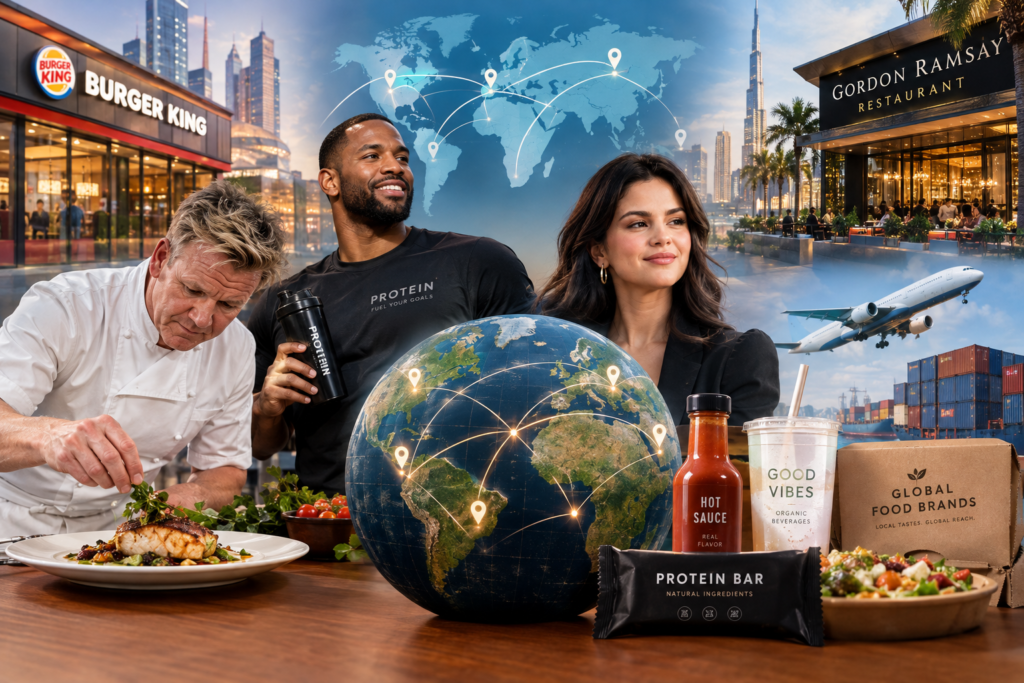
Food industry international expansion is no longer a slow decade-long process reserved for legacy fast-food giants. In 2026 it is happening faster louder and with far more star power than ever before. From athlete-founded protein brands crossing into Europe to celebrity chefs licensing their names for restaurants in Dubai and Seoul the line between entertainment culture and global food business has essentially disappeared.
What used to be a quiet operational strategy opening a few overseas locations signing a distribution deal testing a new market has become front-page entertainment news. Fans track their favorite musicians’ beverage launches the same way they track album drops. Athletes are judged not just on stats but on how well their snack or supplement brand performs on foreign shelves. And celebrity chefs are treated like touring artists opening flagship restaurants in new cities the way a band might announce international tour dates.
This shift matters because food industry international expansion sits at the intersection of business strategy pop culture and consumer trust. Understanding how it works and who is doing it best tells you a lot about where entertainment money and global appetite are heading next.
Why Food Industry International Expansion Is Accelerating Right Now
Several forces are converging at once. Streaming platforms have made regional food trends instantly visible worldwide so a viral dish or drink in Seoul can trend in Los Angeles within days. Social media has turned individual creators and celebrities into instant global marketing engines cutting years off the traditional brand-awareness timeline that international rollouts once required.
At the same time e-commerce and cross-border logistics have matured enough that a mid-sized food brand can test a foreign market without opening a single physical store. This has lowered the barrier of entry dramatically which is one reason so many celebrity-backed labels are moving abroad faster than traditional food conglomerates did a generation ago.
Investors have noticed too. Private equity and venture capital firms increasingly view a well-known face an actor athlete or musician as a built-in marketing asset that reduces the cost of entering a new country. That is a major reason food industry international expansion has become a recurring storyline across entertainment news not just trade publications.
The Biggest Players Driving Food Industry International Expansion
The current wave is led by three overlapping groups: multinational restaurant chains celebrity-founded consumer brands and influencer-led direct-to-consumer labels.
Legacy players like major burger coffee and pizza chains continue to expand aggressively into Southeast Asia the Gulf region and parts of Africa often through master franchise agreements with local operators who understand regulatory and cultural nuances better than a headquarters team ever could.
Meanwhile celebrity-founded brands tequila lines backed by A-list actors hot sauce companies fronted by musicians protein bar startups launched by retired athletes are taking a leaner approach. They typically partner with an established international distributor rather than building infrastructure from scratch which allows food industry international expansion to happen in months rather than years.
The third group influencer-led labels built primarily on social media followings often expands digitally first. They test demand through international shipping and pop-up collaborations before ever signing a formal distribution deal using real purchase data instead of guesswork to decide where to go next.
Key Markets Fueling Global Food Growth in 2026
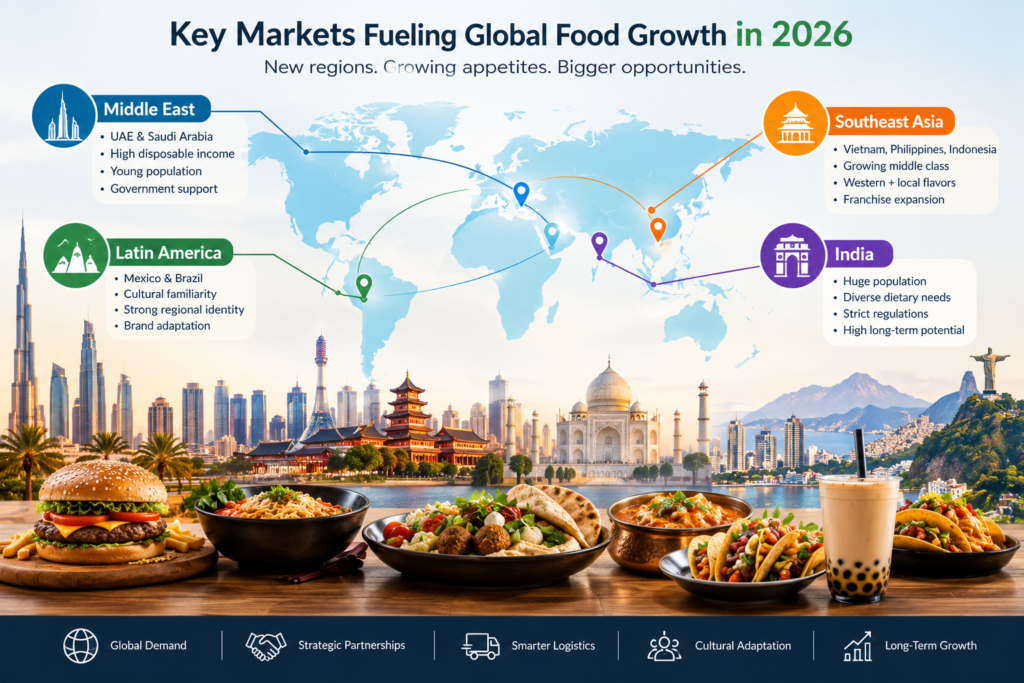
Not every country offers the same opportunity and understanding regional appetite is central to any conversation about food industry international expansion.
The Middle East particularly the UAE and Saudi Arabia remains one of the hottest destinations for American food brands thanks to high disposable income a young population and government initiatives actively courting global retail and hospitality investment. Celebrity restaurant openings in Dubai routinely generate more media coverage than a domestic launch would.
Southeast Asia especially Vietnam the Philippines and Indonesia continues to see rapid growth in franchise-based food expansion driven by a growing middle class and increasing comfort with Western dining formats blended with local flavors.
India presents a uniquely complex but high-reward market. Dietary preferences religious considerations and strict import regulations mean successful expansion requires deep localization but the sheer population size makes it one of the most closely watched targets in global food strategy.
Latin America particularly Mexico and Brazil offers cultural familiarity with American food brands combined with strong regional identity making it a testing ground for how well a brand can adapt without losing its core appeal.
How Celebrity-Backed Food Brands Are Leading International Expansion
Celebrity involvement has evolved well past simple endorsement deals. Today actors athletes and musicians are often founders majority owners or creative directors of the brands themselves which changes how food industry international expansion actually unfolds.
When a well-known musician launches a canned cocktail or a retired NBA player backs a plant-based snack company the brand doesn’t need to build awareness from zero in a new country. Existing fan bases in that market translate almost immediately into curiosity and trial purchases something traditional food companies spend years and enormous marketing budgets trying to achieve.
This is why so many celebrity food ventures now announce international availability alongside their initial U.S. launch rather than treating overseas markets as a future phase. A tequila brand tied to a Hollywood A-lister for example might launch simultaneously in the U.S. U.K. and Australia leveraging the star’s existing global fan base across all three markets at once.
The risk of course is that celebrity attention fades faster than a food brand’s operational foundation can be built. Analysts increasingly separate brands with genuine product quality and supply chain discipline from those coasting purely on a famous name a distinction that becomes obvious the moment international demand outpaces what the company can actually deliver.
Franchise Models and Licensing Strategies for Global Growth
Franchising remains the backbone of large-scale food industry international expansion particularly for chains that need physical locations to deliver their product experience.
Master franchise agreements allow a company to license its entire brand and operating system to a local partner who then develops the market often opening dozens of locations over several years. This model shifts much of the financial risk and regulatory navigation to a partner who already understands local labor laws supply chains and consumer behavior.
Licensing works differently for celebrity and packaged goods brands where the product itself a sauce a beverage a snack moves through existing retail and grocery distribution networks rather than requiring standalone stores. This is generally faster and cheaper which explains why so many celebrity-founded labels favor licensing deals with international distributors over building company-owned locations abroad.
Hybrid approaches are becoming more common too where a brand opens a small number of flagship experience-driven locations in major cities think a chef’s signature restaurant in London or Tokyo while relying on licensing and grocery distribution for broader market penetration in the same country.
Supply Chain and Logistics Challenges in Food Industry International Expansion
Even the most famous name in the world can not overcome a broken supply chain and this is where food industry international expansion often stalls before it even starts.
Perishable goods face the steepest hurdles requiring cold-chain logistics that vary dramatically in reliability from country to country. A beverage or snack brand expanding into a market with underdeveloped refrigerated shipping infrastructure may need to completely rethink packaging shelf life or even the product formula itself.
Sourcing local ingredients is another major consideration. Many brands discover that recreating their exact U.S. product overseas is either prohibitively expensive due to import tariffs or simply unavailable due to ingredient restrictions forcing reformulation that must stay true to the original brand identity while meeting local sourcing realities.
Currency fluctuation and shipping costs add another layer of unpredictability which is why larger companies increasingly favor setting up regional manufacturing hubs rather than exporting finished products from a single home country facility.
Regulatory Hurdles and Food Safety Standards Across Borders
Every country enforces its own food safety labeling and import regulations and this remains one of the most underestimated parts of food industry international expansion.
The European Union for instance maintains stricter rules around food additives preservatives and labeling transparency than the United States meaning a product popular domestically may require reformulation before it can legally be sold in France or Germany. The same applies to markets like Japan and South Korea where ingredient approval processes can take months.
Halal and kosher certification requirements shape product formulation and sourcing decisions across the Middle East Southeast Asia and parts of Europe and brands that fail to secure proper certification early often face costly delays or outright market rejection.
Import tariffs and trade agreements also directly affect pricing strategy. A brand entering a country with high import duties on packaged food may need local manufacturing to remain price-competitive which adds significant upfront investment before a single product reaches shelves.
Cultural Adaptation: Localizing Menus and Products for New Markets
Successful food industry international expansion depends on more than distribution it depends on genuine cultural fluency. Brands that simply export their U.S. product unchanged frequently underperform compared to those willing to adapt.
Fast-food chains have long understood this offering regionally specific menu items that reflect local taste preferences from spice levels to protein choices to entirely unique product lines created exclusively for a single country. This localization signals respect for the market rather than treating it as an afterthought.
Celebrity and lifestyle food brands are catching up to this same principle. A hot sauce brand entering the UK might adjust heat levels to match regional preferences while a snack company entering Japan might introduce limited-edition flavors that speak directly to local culinary trends rather than assuming a one-size-fits-all approach will translate.
Packaging design serving sizes and even the tone of marketing language often need adjustment too since humor imagery and branding cues that resonate in the U.S. do not always carry the same meaning abroad.
Digital Marketing and Influencer Partnerships in Global Food Expansion
Social media has become the single most cost-effective tool for food industry international expansion particularly for brands without massive advertising budgets.
Rather than relying solely on traditional advertising many brands now build local influencer partnerships in each target country before officially launching creating organic buzz and cultural relevance ahead of a formal retail rollout. This approach lets a brand gauge authentic local reception and adjust messaging before committing significant capital.
Celebrity founders bring an additional advantage here: their existing global social media following often overlaps meaningfully with target international markets giving the brand a head start that purely regional influencer campaigns can’t replicate on their own.
Short-form video content in particular has proven effective at introducing new food and beverage products to international audiences quickly especially when the content highlights genuine taste reactions behind-the-scenes production stories or the celebrity founder’s personal connection to the product.
Sustainability and Consumer Trends Shaping Cross-Border Growth
Modern consumers increasingly factor sustainability transparency and ethical sourcing into purchasing decisions and this is reshaping how food industry international expansion gets executed.
European and Australian markets in particular have shown strong consumer preference for brands with clear sustainability credentials from recyclable packaging to responsibly sourced ingredients pushing expanding companies to build these considerations into their international strategy from day one rather than retrofitting them later.
Plant-based and functional food categories continue to see some of the strongest cross-border growth driven by health-conscious consumers and athletes who have helped popularize high-protein low-sugar and clean-label products well beyond their original domestic markets.
Brands that can credibly communicate their sourcing practices environmental impact and health benefits tend to build faster trust in new markets which increasingly matters as much as star power when it comes to long-term international success.
Common Mistakes That Derail Food Industry International Expansion
Not every expansion story ends well and the failures offer just as much insight as the successes. Rushing into a market without adequate research into local competition consumer habits or regulatory requirements remains the most common misstep particularly among celebrity brands riding a wave of initial hype.
Underestimating the cost of building reliable distribution and cold-chain infrastructure has sunk more than a few ambitious launches as has assuming a product’s domestic popularity will automatically translate abroad without adaptation. Overexpansion entering too many markets simultaneously without the operational capacity to support them has also proven costly leading to inconsistent quality that damages brand reputation before it has a chance to establish itself.
Brands that treat international expansion as a long-term commitment requiring sustained investment rather than a quick publicity moment consistently outperform those chasing short-term headlines.
Conclusion
Food industry international expansion has become one of the most dynamic intersections of business strategy and pop culture blending traditional franchise economics with the star power of athletes musicians and actors turned entrepreneurs. The brands succeeding today combine genuine product quality smart regulatory navigation and real cultural adaptation with the marketing advantage that comes from a recognizable name.
As global logistics e-commerce and social media continue to lower the barriers to entering new markets expect food industry international expansion to keep accelerating with celebrity-founded brands playing an increasingly central role in shaping which flavors products and dining concepts go global next. The winners won’t just be the most famous they will be the ones who treat international growth as seriously as they treat their fame.
FAQs
What does food industry international expansion actually involve?
It refers to the process of a food or beverage brand entering new countries through methods like franchising licensing direct exporting or local manufacturing along with the regulatory cultural and logistical adjustments required to succeed there.
Why are so many celebrities launching food and beverage brands internationally?
Celebrities bring built-in global name recognition which significantly lowers the cost and time needed to build brand awareness in a new market compared to a traditional unknown food company.
What is the biggest challenge companies face when expanding food brands abroad?
Supply chain and cold-chain logistics are consistently cited as the toughest hurdle since perishable products require reliable refrigerated transport and storage that varies widely by country.
Do food products need to be reformulated for different countries?
Often yes. Ingredient regulations allergen laws and consumer taste preferences frequently require brands to adjust recipes packaging or labeling to meet local standards and appeal to local palates.
Which international markets are currently the most attractive for food brands?
The Middle East Southeast Asia and parts of Latin America are seeing especially strong growth thanks to expanding middle classes government investment incentives and growing consumer interest in Western food concepts.
How do franchising and licensing differ in international food expansion?
Franchising typically involves a local partner opening and operating physical locations under the brand’s system while licensing usually applies to packaged products distributed through existing retail and grocery channels in the new market.
Can a food brand succeed internationally without celebrity backing?
Absolutely. While celebrity involvement accelerates awareness brands with strong product quality smart localization and reliable distribution partnerships have succeeded internationally without any famous founder at all.