

Most people’s introduction to affiliate marketing starts with small commissions a few dollars here a percentage of a $30 product there. It is a model that requires enormous traffic volume to generate meaningful income. High ticket affiliate marketing flips that equation entirely focusing on fewer higher-value sales instead of chasing volume across low-margin products.
Instead of earning $2 to $10 per sale high-ticket affiliate marketing revolves around commissions in the hundreds or thousands of dollars often tied to software subscriptions coaching programs luxury travel financial services or enterprise tools. A single conversion can outperform dozens or even hundreds of typical affiliate sales combined.
This guide breaks down exactly what high-ticket affiliate marketing is how it works which niches and programs are performing best right now and what it actually takes to succeed with this model in 2026 beyond the oversimplified “just promote expensive stuff” advice that circulates online.
What Is High-Ticket Affiliate Marketing?
High-ticket affiliate marketing refers to promoting products or services with substantially higher price points in exchange for correspondingly larger commissions per sale. While definitions vary slightly across the industry most high ticket affiliate marketing programs pay somewhere between $100 and $500 per conversion at the lower end with premium programs in software coaching and luxury categories paying anywhere from $1000 to $5000 or more for a single sale.
The core appeal is straightforward: instead of needing hundreds of conversions to generate meaningful income high-ticket affiliate marketing allows a smaller number of high-quality sales to produce comparable or often much greater results. That efficiency has made it particularly attractive to content creators niche bloggers and marketers who had rather build depth with a smaller qualified audience than chase raw traffic volume.
It is worth noting that the definition of “high-ticket” has evolved somewhat. In the SaaS and subscription world specifically a commission is increasingly judged by the lifetime value it generates over time rather than a single upfront payout meaning a recurring commission structure that pays out steadily over months can qualify as high ticket even if no individual payment looks dramatic on its own.
How High-Ticket Affiliate Marketing Differs From Traditional Affiliate Marketing
Traditional affiliate marketing especially in categories like fashion beauty or general consumer goods typically pays commission rates in the 5% to 15% range on products often priced under $100. That means earning a meaningful income usually requires either massive traffic or extremely high conversion volume.
High-ticket affiliate marketing operates on fundamentally different math. A single sale of an enterprise software subscription a $3000 online course or a luxury travel package can generate more revenue than dozens of low-ticket sales combined. This changes the entire strategic approach rather than optimizing purely for traffic volume high-ticket affiliate marketing tends to reward deep expertise trust-building content and audiences with genuine purchasing intent and capacity.
It also changes the sales cycle. Low-ticket affiliate purchases are often impulsive decided within minutes. High-ticket affiliate marketing usually involves a longer consideration period meaning content needs to address more detailed objections comparisons and proof points before a reader is ready to convert.
Why High-Ticket Affiliate Marketing Is Gaining Momentum Right Now
A few structural shifts have made high-ticket affiliate marketing a bigger opportunity heading into 2026 than it was even a few years ago. Consumer comfort with high-value online purchases has grown substantially spending several thousand dollars on software coaching or education online which once felt risky has become far more routine.
At the same time audiences have become noticeably better at distinguishing genuine expertise from generic promotional content which actually favors specialists over generalists. When a creator with real demonstrated knowledge recommends a high-ticket solution with specificity and evidence conversion rates tend to run meaningfully higher than a vague broad endorsement a dynamic that rewards niche authority over sheer reach.
B2B and software categories in particular have become a major growth driver within high-ticket affiliate marketing. Businesses tend to be far less price-sensitive than individual consumers; a company won’t hesitate at a $2000-a-month tool if it solves a real operational problem which is part of why enterprise software affiliate programs have become some of the most lucrative corners of the industry.
The Best Niches for High-Ticket Affiliate Marketing
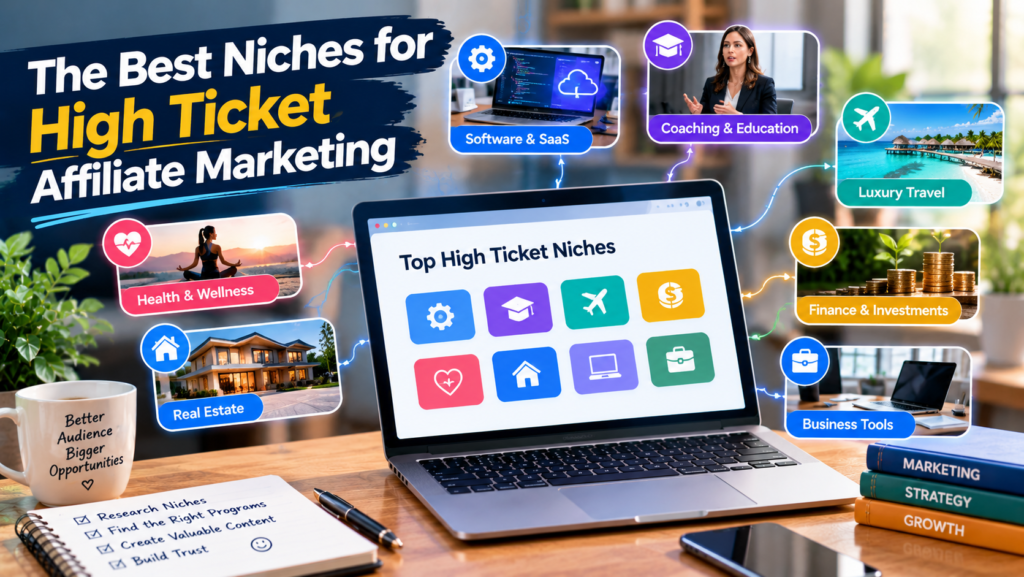
Not every niche lends itself equally well to high-ticket affiliate marketing. The categories performing best right now tend to share a few traits: high price points genuine buyer intent and audiences willing to spend based on trust in a recommendation.
Business software and SaaS remains one of the strongest categories spanning CRM platforms marketing automation tools web hosting and monitoring or security software often paired with recurring commission structures that compound over time.
Online education and coaching continues to perform well particularly in specialized professional or skill-based training where course prices commonly run into the thousands of dollars.
Financial services and fintech offer some of the highest individual payouts in high-ticket affiliate marketing though this category typically comes with stricter compliance and disclosure requirements given regulatory scrutiny around financial advice content.
Luxury travel has become a standout growth category with premium travel affiliate programs now offering commissions ranging from several hundred to several thousand dollars per booking reflecting a broader rebound in high-end travel spending.
Health wellness and specialized equipment round out the list particularly around premium fitness equipment longevity-focused products and specialized medical or wellness devices that carry higher price points than typical consumer health products.
The common thread across all of these niches is that success in high-ticket affiliate marketing depends far more on matching the offer to an audience with real purchasing power and intent than it does on chasing whichever niche has the flashiest headline commission rate.
Real Examples of High-Ticket Affiliate Programs and Commission Structures
Looking at how actual programs structure payouts helps clarify what high-ticket affiliate marketing looks like in practice.
Software hosting platforms like Kinsta and WP Engine commonly offer flat payouts in the $200 to $500 range per referral with some programs adding ongoing recurring commissions on top Kinsta for example has offered a one-time payout alongside a smaller recurring monthly percentage for as long as the referred customer remains subscribed.
CRM and marketing platforms like HubSpot have built some of the more generous recurring structures in the space commonly offering commission rates around 30% of a referral’s spend for up to a year which on enterprise-tier accounts can add up to a substantial total payout well beyond a typical one-time commission.
E-commerce platforms like Shopify offer a hybrid model standard plan referrals often pay in the $25 to $150 range while higher-value referrals like point-of-sale hardware for physical retail businesses can push commissions up toward $500 per sale.
At the premium end luxury travel affiliate programs can pay commissions of several thousand dollars on a single high-value booking particularly in categories like private aviation or luxury yacht charters where average transaction values run dramatically higher than typical consumer travel bookings.
One-Time Payouts vs. Recurring Commissions: Which Actually Wins?
One of the more important strategic decisions in high-ticket affiliate marketing is choosing between programs that pay a large one-time commission versus those offering smaller recurring payouts over time. The math is not always as obvious as it looks on the surface.
A flashy $2000 or $5000 one-time commission sounds impressive but it produces exactly that amount and nothing more. A recurring structure say a 30% commission on a $200-per-month subscription that retains the average customer for a year can generate over $700 in lifetime value from a single referral and considerably more from customers who stay longer. Multiply that across even a modest number of monthly referrals and recurring high ticket affiliate marketing programs can compound into a far more stable predictable income stream than one-off payouts.
There is also a practical consideration around conversion rates. Enterprise-tier offers with the highest headline commissions often come with the smallest realistic buyer pool since most audiences simply are not in a position to purchase a $20000 contract regardless of how compelling the content is. More accessible price points even with smaller individual commissions frequently convert at high enough rates to outperform the “big number” offers once realistic buyer behavior is factored in.
How to Get Started With High Ticket Affiliate Marketing
Breaking into high ticket affiliate marketing successfully requires a more deliberate approach than simply signing up for a program with an attractive commission rate.
Start by identifying a niche where you already have or are genuinely willing to build real credibility. High ticket buyers do more research and scrutinize recommendations more carefully than impulse shoppers which means generic or thin content tends to convert poorly regardless of the commission size on offer.
From there research programs carefully rather than chasing the highest advertised payout. Look closely at cookie duration payment terms product quality and whether the commission structure includes recurring revenue since these details significantly affect real-world earning potential more than the headline number alone.
Building the right kind of content matters just as much as picking the right program. Detailed comparison content in-depth reviews backed by real usage or testing and case studies tend to perform far better in high ticket affiliate marketing than short-form promotional posts since they address the more thorough evaluation process high-ticket buyers typically go through before committing to a purchase.
Building Trust and Content That Actually Converts High-Ticket Offers
Because high-ticket affiliate marketing generally involves a longer buying journey the content strategy behind it looks meaningfully different than what works for low-ticket impulse-driven products.
In-depth experience-based content consistently outperforms generic promotional copy in this space. Buyers considering a significant purchase want to see specific credible detail real screenshots documented results honest pros and cons rather than vague enthusiasm. This aligns closely with Google’s broader emphasis on E-E-A-T where content demonstrating genuine first-hand experience and expertise tends to both rank better and convert better.
Transparency also plays a bigger role than many affiliates expect. Clearly disclosing the affiliate relationship being upfront about downsides or limitations of a product and avoiding exaggerated income or results claims all build the kind of trust that high-ticket purchase decisions depend on. Audiences considering a $2000 purchase are far more skeptical than someone deciding whether to buy a $20 gadget and content that acknowledges tradeoffs honestly tends to convert better than content that oversells.
Common Mistakes That Undermine High-Ticket Affiliate Marketing Results
A handful of recurring mistakes tend to hold back otherwise promising high-ticket affiliate marketing efforts.
Chasing the highest commission rate without considering audience fit is one of the most common missteps. A program with a massive payout is worthless if your audience has no real intent or budget to purchase it. Mismatched offers promoting enterprise B2B software to a consumer lifestyle audience for example routinely produce disappointing results regardless of how attractive the commission structure looks on paper.
Thin surface-level content is another persistent issue. High-ticket buyers are researching a significant purchase and content that doesn’t go beyond a generic overview rarely earns the trust needed to convert that kind of decision.
It is also worth watching for programs structured around recruiting other affiliates rather than genuine product sales a red flag that resembles pyramid-style schemes more than legitimate high-ticket affiliate marketing. A useful gut check: would you recommend this specific product or service to someone you respect independent of the commission involved? If the honest answer is no it is worth reconsidering the partnership regardless of payout size.
Is High-Ticket Affiliate Marketing Worth It in 2026?
For creators and marketers with an established or buildable niche audience high-ticket affiliate marketing remains a genuinely strong opportunity heading into 2026. The underlying economics are favorable particularly in software and subscription categories where recurring commission structures allow income to compound well beyond a single transaction.
That said it is not a shortcut or a passive income guarantee. Success still requires real audience-building in-depth content creation and patience through a longer sales cycle than low-ticket affiliate marketing typically involves. The creators seeing the strongest results tend to be those who have built genuine credibility in a specific niche rather than those simply plugging high-commission links into generic content.
For anyone willing to put in that groundwork high-ticket affiliate marketing offers a meaningfully more efficient path to real income than chasing volume across low-margin products fewer sales but each one carrying significantly more weight.
Conclusion
High-ticket affiliate marketing represents a fundamentally different approach to affiliate income one built on depth trust and higher-value transactions rather than sheer traffic volume. With commissions commonly ranging from a few hundred to several thousand dollars per sale and recurring structures adding compounding value over time it is a model that rewards specialists who understand their audience deeply over generalists chasing broad reach. The programs niches and content strategies covered here should give you a realistic grounded starting point success in high-ticket affiliate marketing still takes real work but the payoff per sale makes that work considerably more worthwhile.
FAQs
What counts as high-ticket affiliate marketing?
Generally any affiliate commission of $100 or more per sale though many premium programs pay $500 to $5000 or more. In the SaaS world recurring commissions that add up to significant lifetime value are also often considered high ticket.
Is high-ticket affiliate marketing better than regular affiliate marketing?
It depends on your audience and content strategy. High-ticket affiliate marketing generally requires fewer sales to earn meaningful income but typically involves a longer more research-driven buying journey than low-ticket impulse-driven affiliate products.
What are the best niches for high-ticket affiliate marketing?
Business software and SaaS online education and coaching financial services luxury travel and specialized health and wellness products currently rank among the strongest-performing categories.
How much can you realistically earn with high-ticket affiliate marketing?
Earnings vary enormously based on niche audience size and content quality but individual commissions commonly range from a few hundred to several thousand dollars per sale with recurring commission programs capable of compounding into substantial ongoing income.
Do you need a large audience to succeed in high-ticket affiliate marketing?
Not necessarily. A smaller highly engaged niche-specific audience with genuine purchasing intent often converts better in high ticket affiliate marketing than a large unfocused general audience.
Are recurring commissions better than one-time payouts?
Often yes. A smaller recurring commission that continues for months or years can generate more total lifetime value than a single large one-time payout particularly in subscription-based software categories.
How do you find legitimate high-ticket affiliate marketing programs?
Look for established companies with transparent commission structures clear payment terms reasonable cookie durations and real product value. Be cautious of programs that emphasize recruiting other affiliates over actual product sales which often resembles a pyramid structure rather than legitimate affiliate marketing.