


Market development funds are financial resources provided by companies to help their vendors resellers distributors or other channel partners promote products and generate demand. Often referred to as MDF these funds are commonly used in channel sales and partnership programs to support marketing activities that can benefit both the company and its partners.
If you have heard a vendor mention “MDF” during a partner meeting and wondered what it means you are not alone. Market development funds can cover a range of activities from advertising and events to content creation and lead-generation campaigns. This guide explains what market development funds are how they work how companies typically use them and why they matter to businesses that sell through partners.
What Are Market Development Funds
Market development funds usually shortened to MDF are money that a manufacturer or vendor provides to its channel partners to help them market and sell the vendor’s products. Think of a software company that sells through a network of resellers or a hardware manufacturer that relies on distributors to reach customers. Rather than doing all the marketing itself the vendor gives its partners financial support to run local campaigns attend trade shows or promote products in ways that make sense for their specific market.
The core idea is simple: the vendor benefits when its partners sell more so it makes sense to help fund the marketing efforts that drive those sales. A partner in a specific region or industry often understands its customers better than the vendor’s own marketing team does so MDF puts money into the hands of the people closest to the actual buyers.
How Market Development Funds Typically Work
Most Market Development Funds programs follow a similar pattern even though the details vary by company. A vendor sets aside a budget often calculated as a percentage of a partner’s sales or purchase volume from the previous period. Partners then apply for a portion of that budget to fund specific marketing activities.
The process usually looks something like this: a partner submits a request describing what they want to do whether that is a webinar a local advertising campaign a customer event or sponsored content. The vendor reviews the request against program guidelines approves or adjusts the amount and the partner carries out the activity. Afterward the partner typically has to submit proof that the money was spent as planned along with some kind of reporting on results.
Some programs distribute funds automatically based on a formula while others require a formal proposal and approval process for every activity. Larger more mature MDF programs tend to have more structure including online portals where partners submit claims and track approvals.
Market Development Funds Versus Co-Op Funds
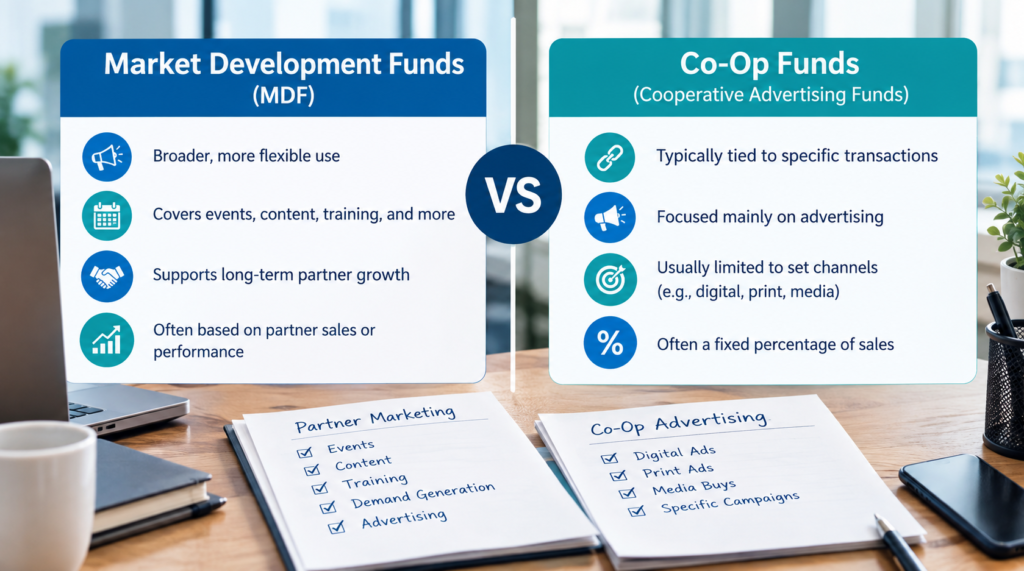
People often confuse market development funds with co-op funds and while they are related they are not the same thing. Co-op or cooperative advertising funds are usually tied directly to a specific transaction or a fixed percentage of sales and they’re often restricted to advertising activities like print ads digital ads or sponsored placements.
MDF tends to be broader and more flexible. It can cover a wider range of marketing activities beyond just advertising including events training content creation and demand generation campaigns. Some companies use the terms interchangeably in casual conversation but if you are managing a partner program or trying to access funds as a partner it is worth checking exactly how your specific vendor defines each term since the rules and restrictions can differ significantly.
Who Uses Market Development Funds
MDF programs are most common in industries built around indirect sales meaning the vendor does not sell directly to the end customer but instead relies on a network of partners. Technology companies are especially heavy users of Market Development Funds particularly in software hardware telecommunications and IT services where vendors depend on resellers value-added resellers managed service providers and distributors to reach customers across different regions and industries.
Outside of tech MDF-style programs also show up in industries like automotive consumer packaged goods and franchising anywhere a central company relies on a network of partners or franchisees to represent its brand locally. The underlying logic stays the same across industries: local partners often have market knowledge customer relationships or geographic reach that the central company does not have on its own.
Why Companies Create Market Development Funds Programs
From the vendor’s perspective MDF serves a few different purposes at once. It strengthens the relationship with partners by giving them a tangible reason to prioritize the vendor’s products over competitors. It also extends the vendor’s marketing reach without requiring the vendor’s own team to execute every local campaign which would be impractical across dozens or hundreds of markets.
There’s also a competitive angle. In industries where multiple vendors compete for the same partners’ attention a generous and well-run MDF program can be a deciding factor in which vendor a partner chooses to promote more actively. Partners generally have limited time and resources so they tend to focus their energy on the vendors that make it easiest and most rewarding to do so.
For partners Market Development Funds represents real financial support that lowers the cost of marketing activities they might not otherwise be able to afford especially smaller partners without large marketing budgets of their own.
Common Uses for Market Development Funds
The specific activities eligible for Market Development Funds vary by program but common categories include:
Trade shows and events where partners use funds to cover booth costs event registration or hosting customer gatherings. Digital marketing campaigns including paid search social media advertising and email marketing aimed at generating leads. Content creation such as case studies videos or localized marketing materials that partners can use with their own customers. Training and certification programs that help partner sales teams understand the vendor’s products well enough to sell them effectively. Sales enablement tools including things like customer-facing presentations or demo environments.
Most vendors publish a list of pre-approved activities along with any activities that are explicitly excluded so partners know what they can and can’t request funding for before they submit a proposal.
Challenges With Market Development Fund Programs
MDF programs sound straightforward but they come with real friction points that both vendors and partners run into regularly.
For partners the application and reporting process can be tedious especially for smaller companies without dedicated marketing or administrative staff. If a program requires detailed proposals and extensive documentation just to access a modest amount of funding some partners decide it is not worth the effort and simply do not participate.
For vendors tracking how Market Development Funds is actually spent and measuring whether it produced real results can be difficult particularly across large partner networks. Without good tracking it is hard to know whether the funds are driving genuine sales growth or just being absorbed into partner marketing budgets with little accountability. This is part of why many larger vendors have moved toward specialized software platforms built specifically to manage MDF claims approvals and reporting.
There is also a fairness question that comes up in larger channel programs. Bigger partners with more resources and marketing sophistication often find it easier to access and use MDF effectively while smaller partners may struggle to compete for the same pool of funds or to execute campaigns that meet a vendor’s reporting requirements.
How Partners Can Get the Most Out of MDF
Partners who want to make effective use of market development funds generally benefit from understanding the vendor’s program guidelines closely before submitting any requests. Programs often have specific rules about what qualifies deadlines for submission and requirements for proof of execution and missing these details can mean funds go unused or claims get rejected.
It also helps to plan Market Development Funds activities around a partner’s actual sales strategy rather than treating the funds as a bonus to spend on whatever seems convenient. Activities that align with a partner’s existing customer base and sales goals tend to produce better results and vendors are more likely to continue offering support to partners who can demonstrate that the funds led to measurable outcomes.
Keeping organized records throughout the process rather than scrambling to pull together documentation after the fact also makes the reporting requirement far less painful when it comes time to submit a claim.
Final Thought
Market development funds are ultimately a tool for aligning incentives between vendors and the partners who sell on their behalf. When they are well designed and reasonably easy to access they can genuinely help smaller companies market themselves more effectively while giving vendors a wider reach than they could achieve alone. The programs that tend to work best are the ones that balance enough structure to ensure accountability with enough simplicity that partners actually bother to use them.
FAQs
What is the difference between MDF and co-op funds?
Co-op funds are usually tied to specific transactions and restricted to advertising while MDF is broader and can cover events training content and other marketing activities beyond straight advertising.
How is an MDF budget usually calculated?
Most vendors calculate MDF as a percentage of a partner’s sales or purchases over a given period though the exact formula and percentage vary widely by company and industry.
Do partners have to pay MDF back if a campaign does not work?
This depends on the vendor’s program terms. Some programs only require proof that funds were spent on approved activities while others may claw back unused or misspent funds; partners should check their specific agreement.
Can small partners access market development funds?
Yes though smaller partners sometimes find the application and reporting requirements more burdensome relative to the amount of funding available which can make participation less attractive.
Is MDF considered taxable income for partners?
This depends on how the funds are structured and local tax regulations so partners should consult a tax professional rather than relying on general information for this kind of decision.