

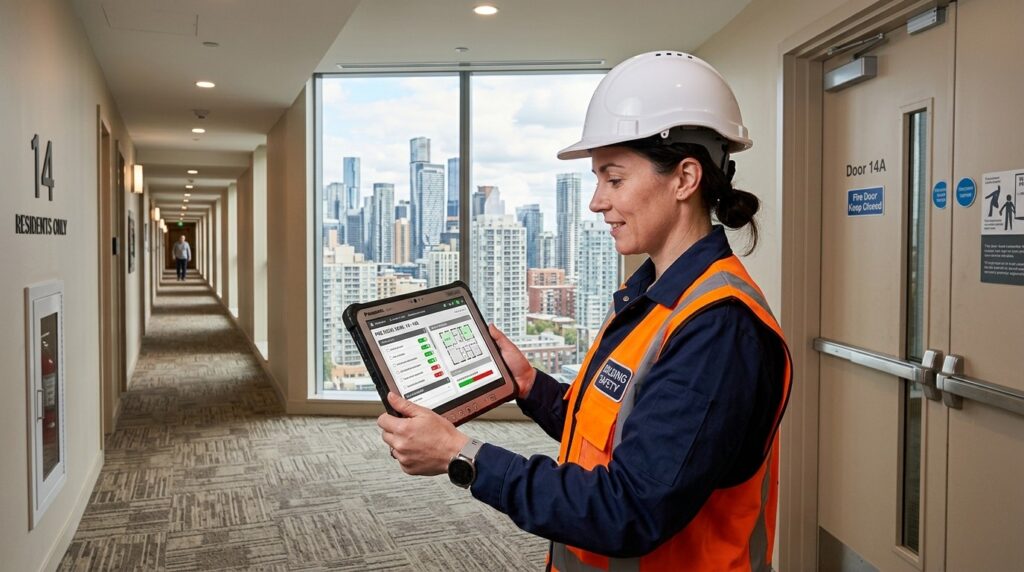
Golden thread AI is the growing use of artificial intelligence to build organize and check the digital record of safety information that owners and builders of higher-risk buildings in England must keep accurate and accessible for the life of the building. The phrase combines two ideas that are often confused. “Golden thread” is not an AI term at all: it comes from UK building regulation where it refers to that record of safety information. The “AI” half describes the tools now being applied to it. If you are trying to work out where the technology helps where it does not and what to ask a software vendor this guide covers both halves of the phrase.
What the golden thread AI is
The concept behind Golden Thread AI comes from Dame Judith Hackitt’s independent review of building regulations and fire safety following the 2017 Grenfell Tower fire. Her 2018 report Building a Safer Future recommended maintaining a “golden thread” of high-quality information a complete record of a building’s design construction and maintenance that can support safe management throughout its life.
The recommendation was later incorporated into the Building Safety Act 2022. Government guidance explains that the golden thread should help dutyholders demonstrate that a completed building and later work comply with building regulations while supporting the identification and management of risks such as fire spread and structural failure. The information should be accessible reliable accurate and kept up to date.
Which buildings it applies to
The legal duty covers higher-risk buildings. One industry explainer describes them as residential buildings of at least 18 meters or seven storeys with two or more residential units. Another source notes that regulator and industry guidance treat the golden thread as best practice for all buildings but the legal duty applies only to higher-risk ones. This is an England-focused regime so anyone working elsewhere should check local rules.
Responsibility shifts over time. During design and construction the client principal designer and contractors share the job. After construction the accountable person takes over coordinating and maintaining it.
What the rules say about format
The regulations require the information to be kept electronically and be capable of being transferred electronically to other people. They do not prescribe a particular format or software. The regulations do list what must be included and one legal guide summarizes it as two categories: design and construction information (as-built plans fire strategy materials approvals) and occupation information (safety case fire risk assessments maintenance records emergency plans).
The stakes are not only administrative. According to one law firm’s guide a breach can result in criminal liability. For example an accountable person who stops being responsible for a building and fails to hand over the golden thread can be prosecuted with a fine and up to two years’ imprisonment possible.
Why AI enters the picture

The hard part of the golden thread is not storing files. It is keeping information consistent across many teams systems and years. A typical building’s record might include CAD models PDFs photographs inspection reports and emails produced by different companies in different formats. One critic of the filing-cabinet approach describes a fire risk assessment buried in a SharePoint folder and an out-of-date drawing sitting beside it and argues that this is exactly the failure the golden thread is meant to prevent.
That is the gap AI vendors and consultants target. The real-world uses fall into a few groups.
Structuring and converting information
An article in BIM+ by two consultants from Okana argues that AI can simplify integration by handling format conversion and improving interoperability between systems. Turning a scanned PDF into searchable structured data or matching documents to the right building component is the kind of tedious work machine learning handles reasonably well.
Capturing information on site
Some products focus on getting data in. One vendor says its conversational AI makes recording compliance data as easy as having a chat. Another offers reality capture using 2D and 360-degree photos video and drone imagery with AI analysis on top. The idea is that a photo record taken during construction such as fire stopping behind a wall can be logged and linked to the record before it is covered up.
Keeping the record current
A BuildTwin product page describes AI tracking and automated quality checklists meant to keep the digital record up to date plus automated request-for-information management so each change is documented. Whether a tool actually does this reliably is something to test not assume.
Search and retrieval
A less glamorous but practical use is finding things. When a fire and rescue service the Building Safety Regulator or a new accountable person asks for information someone has to locate it quickly. AI-assisted search across a large document set can save hours provided the underlying record is clean.
What AI does not change
The legal duty stays with people. The accountable person and dutyholders must be able to demonstrate compliance which means an AI system that produces a confident summary is not a substitute for a verified record. Several points follow from that.
- Accuracy is still the requirement. The Building Safety Act asks for the thread to be accurate up to date and accessible. An AI tool that extracts a fire rating incorrectly or links a document to the wrong floor damages the record rather than improving it.
- Audit trails matter. One vendor page stresses that every change to the golden thread must be traceable. Any AI that edits tags or classifies records should log what it changed and who approved it.
- Garbage in garbage out. AI applied to incomplete or inconsistent records tends to produce polished but incomplete results. Fixing data quality usually comes first.
- Treat AI like a new colleague. The BIM+ authors use that framing: useful but supervised with its work checked.
Much of the public content on this topic is written by software vendors and their claims are marketing not independent evidence. A vendor’s statement that its tool reduces the risk of regulatory penalties is a sales claim. Ask for named customers and a demonstration on your own documents.
Questions to ask before buying a golden thread tool
- Can the system export the full record in a format someone else can use and can it be transferred electronically to a new accountable person?
- Does it keep version history and a clear audit trail for every AI-generated change?
- Where is the data hosted who can access it and what security certifications does the vendor hold?
- How does the AI handle errors and who reviews its output?
- Does it cover both design and construction information and occupation information?
- What happens to your data if you leave the vendor?
Certifications are worth checking rather than accepting on faith. Vendors mention things like ISO/IEC 27001 alignment Cyber Essentials or hosting in UK cloud regions and some describe certification as still in progress so read that wording carefully.
This is general information not legal advice. Duty holders should take advice on their specific obligations.
The regulatory picture is still moving
The rules are not frozen. The UK government consulted on a Single Construction Regulator between December 2025 and March 2026 and published its response on 9 July 2026. According to one industry commentary it confirmed the intention to move toward a more integrated regulatory model though implementation is not expected before 2028. The same piece argues that golden thread principles could carry over to infrastructure such as bridges and tunnels. That is one writer’s view of where things may go not a settled policy.
The bottom line
The golden thread is about trustworthy information and AI is only as good as the record it works on. Used carefully for conversion capture and search it can reduce the manual burden of keeping a complex record current. Used as a shortcut around verification it adds risk to the one place where accuracy matters most. Get the information discipline right first then bring in the automation.
Frequently asked questions
What is the golden thread in simple terms?
It is a single digital always up-to-date record of a higher-risk building’s safety information from design through construction to occupation so the people responsible can manage risks and prove compliance.
Is the golden thread a legal requirement?
For higher-risk buildings in England yes under the Building Safety Act 2022 and related regulations. Guidance treats it as good practice for other buildings but the legal duty applies to higher-risk ones.
Does the law require AI for the golden thread?
No. The regulations require the information to be electronic and transferable but do not prescribe any software or technique. AI is an optional tool.
What can AI do for the golden thread?
It can help convert and structure documents capture site data search large records and flag missing or outdated information. It cannot take over legal responsibility for accuracy.
What are the risks of using AI here?
Errors in extraction or classification weak audit trails poor data quality feeding the system and over-reliance on vendor promises. Human review and a clear record of changes reduce these risks.