

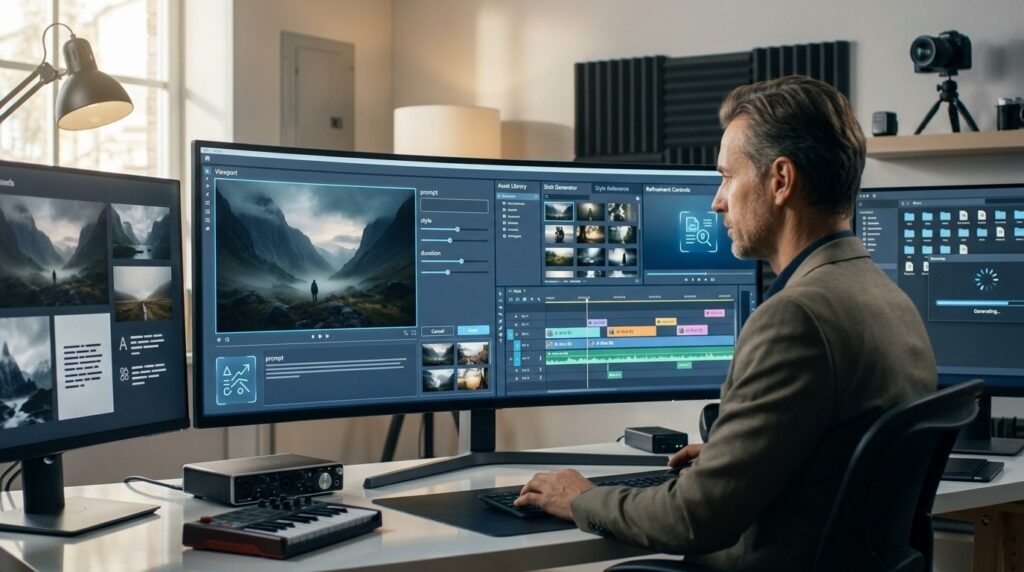
AI video generation news has moved well beyond the stage where a short text prompt produces a novelty clip. In 2026 the technology is increasingly being built into professional creative workflows marketing platforms enterprise software and consumer apps.
The biggest developments in recent AI video generation news include better control over characters and scenes native audio image-to-video generation conversational editing lower-cost models for developers and the integration of multiple video models into creative platforms. At the same time OpenAI’s Sora has been discontinued while companies such as Google Runway Luma Adobe and Meta continue expanding their video capabilities.
The result is a rapidly changing market in which the important question is no longer simply whether AI can generate video. The bigger question is how reliably it can produce usable video at the quality cost speed and level of control that creators and businesses require.
AI Video Generation News at a Glance
Several developments stand out in 2026:
- Google has continued expanding Veo including Veo 3.1 Veo 3.1 Lite and video creation through Gemini-powered products.
- Google introduced Gemini Omni which combines multiple types of input for video creation and conversational editing.
- Runway’s Gen-4.5 has become a major part of its current video-generation workflow supporting text-to-video and image-to-video.
- Luma’s Ray3.14 focuses on faster and less expensive generation while adding native 1080p output.
- Adobe Firefly has increasingly become a multi-model creative environment offering access to several third-party video models.
- Meta continues integrating AI video creation and editing into its consumer and creator products.
- OpenAI discontinued the Sora web and app experience in April 2026 and subsequently shut down the Sora API in September.
- China is developing an increasingly organized AI-video production ecosystem including government and local-industry support for AI filmmaking.
Together these developments show a shift from isolated AI video models toward broader video-production ecosystems.
Google Pushes AI Video Toward More Controlled Creation
Google has been one of the most active companies in AI video generation.
Its Veo family has evolved from basic text-to-video generation toward workflows that give creators more control over characters scenes styles formats and audio.
Veo 3.1 supports image-based video creation and reference inputs designed to improve consistency. Google has also added native vertical video generation which is particularly relevant to Shorts and other mobile-first formats.
Another notable development is higher-resolution output. Google has promoted 1080p and 4K capabilities in its Veo workflows giving the technology a wider range of potential professional uses.
This matters because early generative video systems often produced impressive individual shots but struggled to maintain consistency across a broader production. Reference images character consistency camera controls scene extension and improved prompt adherence address some of those practical problems.
Veo 3.1 Lite targets developers
Google has also moved toward making video generation cheaper for application developers.
Veo 3.1 Lite was introduced as a more cost-efficient member of the Veo family. It supports text-to-video and image-to-video generation different aspect ratios and multiple resolutions.
Lower generation costs are significant because developers building video applications may need to generate thousands or millions of clips. A model that looks impressive but costs too much to operate can be difficult to turn into a sustainable product.
The competition is therefore moving on two fronts: output quality and economics.
Gemini Omni Brings Video Creation and Editing Together
Google’s Gemini Omni is another important part of the 2026 AI video generation story.
Rather than treating video generation as a standalone prompt-to-clip process Gemini Omni is designed to work across different types of input. Users can combine text images audio and video as part of the creation process.
Google has also positioned Omni around conversational editing. Instead of repeatedly returning to traditional editing controls a creator can describe a change and have the system modify the video.
This points toward a broader change in video software.
Traditional video editing generally requires users to understand timelines layers transitions effects color adjustments and other controls. AI-assisted editing does not eliminate those concepts but it can provide another interface: natural language.
For marketers small businesses educators and social-media creators that could make sophisticated video editing more accessible.
Runway Continues Focusing on Professional Video Workflows
Runway remains an important company in the generative-video market with Gen-4.5 representing its current advanced video-generation model.
Gen-4.5 supports both text-to-video and image-to-video workflows. It is designed to handle detailed prompts involving camera movement scene composition timing and motion.
One of the more interesting changes is that Runway is moving beyond a single-generation model toward a broader creative environment.
Its platform includes tools for generation editing workflows and AI-assisted creative production. Runway has also introduced an agent-oriented approach intended to help users produce multi-shot video through conversation.
This reflects a larger industry trend.
Instead of asking users to generate one clip at a time AI video platforms increasingly want to help create an entire sequence of shots.
That could be more valuable to professional users because a finished advertisement product video explainer or short film normally requires multiple connected scenes rather than one isolated clip.
Luma’s Ray3.14 Focuses on Speed and Cost
Luma has also continued improving its Dream Machine video-generation technology.
Ray3.14 released in January 2026 brought native 1080p generation along with claims of substantially faster and less expensive generation compared with its predecessor.
The model also focuses on better motion consistency and improved prompt adherence.
The importance of this development is easy to overlook. AI video quality gets much of the attention but production economics may ultimately determine which technologies businesses actually use.
If a marketing team needs hundreds of short product clips for example the difference between an expensive generation workflow and a lower-cost one can become significant.
Faster generation also makes experimentation easier. Creators can test more variations instead of spending a large amount of time or money on each attempt.
Adobe Is Turning Firefly Into a Multi-Model Video Hub
Another major development is happening inside Adobe’s creative ecosystem.
Adobe Firefly increasingly allows users to access both Adobe’s own generative models and selected partner models.
In 2026 Adobe documentation lists video models from providers including Google Runway Luma and Kling among the models available through supported Firefly experiences.
This represents an important change in how creative AI platforms may compete.
Instead of trying to convince users that one model is suitable for every project a platform can provide multiple models and let users choose based on the job.
One model might be better suited to realistic motion. Another might provide a particular visual style. A third might offer faster or cheaper generation.
For professional teams the platform surrounding the models can therefore become almost as important as the model itself.
Adobe is also focusing on enterprise workflows governance brand consistency and integration with broader creative and marketing processes.
That is particularly relevant to businesses that need to produce large volumes of branded content rather than experimental AI clips.
Meta Is Bringing More AI Video Creation Into Social Platforms
Meta has continued expanding AI-assisted video creation and editing across its ecosystem.
Its AI tools have increasingly included video-generation and editing capabilities while the company’s 2026 subscription products also offer increased access to AI media generation.
For creators this development matters because AI video is moving closer to the platforms where content is actually published.
A creator may no longer need to generate a video in a separate specialist application export it and then upload it to a social network. Increasingly generation editing personalization and publishing can happen within connected ecosystems.
That could be particularly important for short-form content where speed and volume are often major parts of the production process.
OpenAI’s Sora Story Took an Unexpected Turn
One of the biggest pieces of AI video generation news in 2026 is not a new model but the discontinuation of one.
OpenAI’s Sora product including its web and app experiences was discontinued on April 26 2026. The Sora API was subsequently scheduled for discontinuation on September 24 2026.
That is notable because Sora became one of the best-known names in AI video generation after its original introduction.
Sora 2 had been presented as a more realistic and controllable video-generation model with synchronized dialogue and sound effects. OpenAI also introduced safety and provenance measures around generated content.
The discontinuation illustrates an important point about the generative-AI market: a highly visible product can still disappear even while the broader technology continues developing rapidly.
For users it is a reminder not to build an entire production strategy around a single AI platform without considering its long-term availability export options pricing and alternatives.
AI Video Is Becoming More Multimodal
One of the clearest trends across the industry is the movement from simple text-to-video generation toward multimodal creation.
Modern systems increasingly accept combinations of:
- Text prompts
- Reference images
- Existing video
- Audio
- Character references
- Style references
- Story or scene instructions
This allows creators to provide more information about what they want.
For example instead of writing a prompt describing a product from scratch a marketer might provide a product image specify the desired camera movement provide a reference style and ask the model to generate a short promotional sequence.
That approach is more useful for commercial work because businesses usually have existing brand assets and visual references.
AI Video Generation Is Becoming More Useful for Marketing
Marketing is one of the areas where these developments could have a practical impact.
Businesses can use generative video for tasks such as:
Social media content
Short vertical videos can be created for platforms that prioritize mobile-first content.
Product demonstrations
A product image can potentially become an animated demonstration or promotional scene without a complete traditional production.
Advertising concepts
Marketing teams can create early visual concepts before committing to expensive filming.
Storyboards and previsualization
AI-generated scenes can help teams explore camera angles environments and creative directions before production.
B-roll and supporting footage
Generative video can potentially fill gaps in existing footage or create visual material for presentations and campaigns.
However AI-generated video does not automatically replace professional production.
Businesses still need creative direction brand judgment fact checking editing legal review and quality control.
The Biggest Challenge in AI Video Generation News Is Still Reliability
While AI video quality has improved substantially AI Video Generation News continues to highlight a major challenge: reliability. AI-generated videos can still produce inconsistent characters unnatural motion strange physical interactions incorrect details and continuity issues. Getting the exact desired result often requires multiple attempts.
Long-form consistency remains particularly difficult. A five-second AI-generated clip may look highly convincing but a sequence containing dozens of connected shots can expose inconsistencies in characters environments objects lighting and movement.
This is why developments covered in AI Video Generation News including reference images scene extension conversational editing multi-shot workflows and production-focused tools are becoming increasingly important.
The industry is moving beyond the goal of creating a single impressive clip. The bigger objective is to generate multiple reliable usable clips that maintain visual and narrative consistency throughout an entire production.
Copyright and Content Provenance Remain Major Issues
AI video development also comes with legal and trust questions.
Creators and businesses need to understand the rights associated with both the material they provide to an AI system and the generated output.
Another concern is identifying AI-generated content.
Provenance technologies such as C2PA Content Credentials and digital watermarking are becoming increasingly important as synthetic media becomes more realistic.
The issue is not simply whether a video looks real. Viewers publishers advertisers and platforms increasingly need ways to determine where media came from and whether it has been altered.
That makes provenance infrastructure an important part of the AI video ecosystem rather than a secondary technical feature.
China Is Building an AI Video Production Industry
AI Video Generation News is increasingly highlighting China’s growing role in the global AI video industry. Recent developments indicate that Chinese cities and industrial parks are supporting AI filmmakers and video-production companies through incentives computing resources and technology-focused industry clusters.
The scale of experimentation is significant but the industry also faces challenges involving copyright originality market saturation and the potential impact of AI-generated production on traditional creative jobs.
This trend is important globally because AI Video Generation News is no longer focused only on developments from a small number of U.S. companies. AI video is becoming part of a broader international technology competition with Chinese companies and creators developing their own models applications and production ecosystems.
Chinese teams are also experimenting with AI-generated films and serialized content showing how AI video technology is expanding from individual clips toward larger-scale creative and production workflows.
What the Latest AI Video Generation News Means for Businesses
The most important lesson for businesses is that AI video is becoming a production tool rather than simply a demonstration of artificial intelligence.
A business considering these technologies should look beyond the visual quality of a model.
Useful questions include:
- How consistent are characters and products across multiple shots?
- Can the system work with existing brand assets?
- How much does each usable clip actually cost?
- How quickly can the team generate revisions?
- Can the output be edited in an existing production workflow?
- What are the commercial-use and licensing terms?
- Does the platform provide provenance or watermarking features?
- What happens if the provider changes or discontinues the product?
These questions are more useful than asking which AI video model is simply the most impressive.
Where AI Video Generation Is Heading
The direction of the industry is becoming clearer. AI Video Generation News increasingly points toward multimodal creation greater production control conversational editing lower-cost generation and integrated creative workflows.
The next stage is unlikely to focus only on longer clips or higher resolution. More important advances will include maintaining consistency across scenes controlling specific characters and objects understanding complex instructions editing existing footage naturally and connecting AI generation with broader production workflows.
The business opportunity may therefore extend beyond standalone video generation. A platform that can take a marketing brief generate a sequence maintain brand consistency revise scenes add audio create multiple aspect ratios and organize final assets could provide significantly more value to businesses than a tool designed only to generate individual clips.
Final Thoughts
The latest AI video generation news shows an industry moving quickly from experimentation toward production.
Google is expanding Veo and Gemini-powered video workflows. Runway is developing increasingly sophisticated creative tools. Luma is focusing on speed cost and quality. Adobe is bringing multiple video models into a broader creative environment. Meta is moving AI video closer to social content creation. Meanwhile OpenAI’s Sora discontinuation demonstrates how quickly the competitive landscape can change.
For creators and businesses the practical takeaway is simple: AI video is becoming more capable but choosing a tool should depend on the production problem rather than the hype surrounding a particular model.
The strongest workflows will likely combine generative AI with human creative direction editing brand judgment and quality control.
Frequently Asked Questions
What Is the Latest Trend in AI Video Generation?
The latest AI Video Generation News shows a shift from basic text-to-video tools toward more multimodal and controllable video creation using text images audio references and advanced editing workflows.
Which companies are developing AI video generation technology?
Major participants include Google Runway Luma Adobe Meta and several Chinese AI companies. The competitive landscape changes quickly as companies release new models and integrate video generation into broader products.
Is AI Video Generation Becoming Cheaper?
Yes. AI Video Generation News shows a growing focus on lower-cost models and faster video generation. Google’s Veo 3.1 Lite and Luma’s Ray3.14 are examples of efforts to make AI video creation more affordable and efficient.
Can AI video generators create professional videos?
They can produce increasingly sophisticated footage but professional results often require multiple generations human editing creative direction and quality control. The technology is not equally reliable for every type of production.
Is OpenAI Sora still available?
No. OpenAI discontinued the Sora web and app experiences on April 26 2026 and the Sora API was discontinued on September 24 2026.
What Should Businesses Consider Before Using AI-Generated Video?
Businesses following AI Video Generation News should consider factors such as output quality consistency costs commercial-use terms data handling content provenance workflow integration and the long-term availability of the AI video platform.