

Introduction
Finding reliable information online for children is harder than it should be. The internet is enormous largely unfiltered and built primarily for adults. Most search results lead to content that is either too complex poorly sourced or buried under advertisements that have no business appearing in front of a ten-year-old. That is the problem Britannica Kids was designed to solve and it does so with a level of credibility that very few educational platforms can match.
Britannica Kids carries the weight of one of the most trusted names in reference publishing. The Encyclopaedia Britannica has been a standard for factual accuracy since 1768 and the children’s platform brings that same editorial discipline into a format built specifically for young readers. Whether a child is working on a school report satisfying their own curiosity or being guided through a research project by a teacher Britannica Kids gives them access to information that has been written reviewed and organized with their age group specifically in mind. That combination of credibility and accessibility is what sets it apart from a general internet search.
What Britannica Kids Actually Is
Britannica Kids is a digital educational reference platform operated by Encyclopaedia Britannica designed to serve students from early elementary through middle school. The platform is divided into three distinct levels Kids Students and Young Adults each calibrated for a different reading level and depth of content. This tiered structure means a second grader and a seventh grader are not reading the same version of an article about the water cycle. The content scales with the reader which is a practical feature that a surprising number of educational platforms still get wrong.
The platform covers a wide range of subjects including science history geography animals biographies arts and current events. Articles are written by professional editors and reviewed for accuracy before publication which distinguishes the content from crowd-sourced encyclopedias or general websites where anyone can add or alter information. For students who are learning how to evaluate sources and cite their research Britannica Kids offers something genuinely valuable a platform where the sourcing question is already answered before the child even starts reading.
The Three Levels and Who They Are Built For
The structure of Britannica Kids is one of its most practical features for schools and households managing children of different ages. The Kids level targets readers roughly in the kindergarten through fourth grade range using simpler vocabulary shorter articles and more visual support to make information accessible to early readers. Articles at this level prioritize clarity over depth giving young students a solid foundational understanding of topics without overwhelming them with detail.
The Students level steps up the complexity for readers in grades five through eight introducing more nuanced explanations longer articles and a broader range of subtopics within each subject area. The Young Adults level moves closer to a standard encyclopedia format appropriate for high school students who need reliable reference material for more demanding academic work. Having all three levels under the same platform means a family or classroom can work within a single trusted resource as students grow rather than migrating between different tools at different grade levels.
Content Quality and Editorial Standards
The thing that separates Britannica Kids from most of what children encounter online is the editorial process behind the content. Articles are written by subject experts and professional editors not generated automatically or contributed by anonymous users. Every piece of content goes through a review process before it is published and the platform is updated regularly to reflect current information particularly in areas like science geography and world events where facts change over time.
This matters enormously for students who are developing their research skills and learning to distinguish between reliable and unreliable sources. A child who builds their research habits around Britannica Kids learns early that good information comes with authorship editorial oversight and a clear organizational structure. Those habits transfer directly to academic work at higher levels where the ability to evaluate sources is as important as the ability to find them. The platform is not just delivering facts it is modeling what trustworthy information looks like.
How Schools Use Britannica Kids
Britannica Kids is widely used in American classrooms both as a primary research tool and as a supplementary resource for reading and comprehension exercises. Many school districts license the platform at the institutional level giving students access through their school accounts without requiring individual family subscriptions. Teachers integrate it into research projects science units social studies lessons and independent reading assignments because the reading levels align with curriculum standards and the content is curriculum-relevant by design.
One of the more practical classroom applications is using Britannica Kids as a starting point for research projects rather than a finishing point. Teachers direct students to the platform to build foundational knowledge about a topic before moving into more specialized sources which helps students arrive at those secondary sources with enough background to make sense of what they are reading. It also gives teachers a consistent citable starting point that they know is accurate which simplifies the feedback process when reviewing student work and citations.
Features That Make It Useful Beyond Basic Research
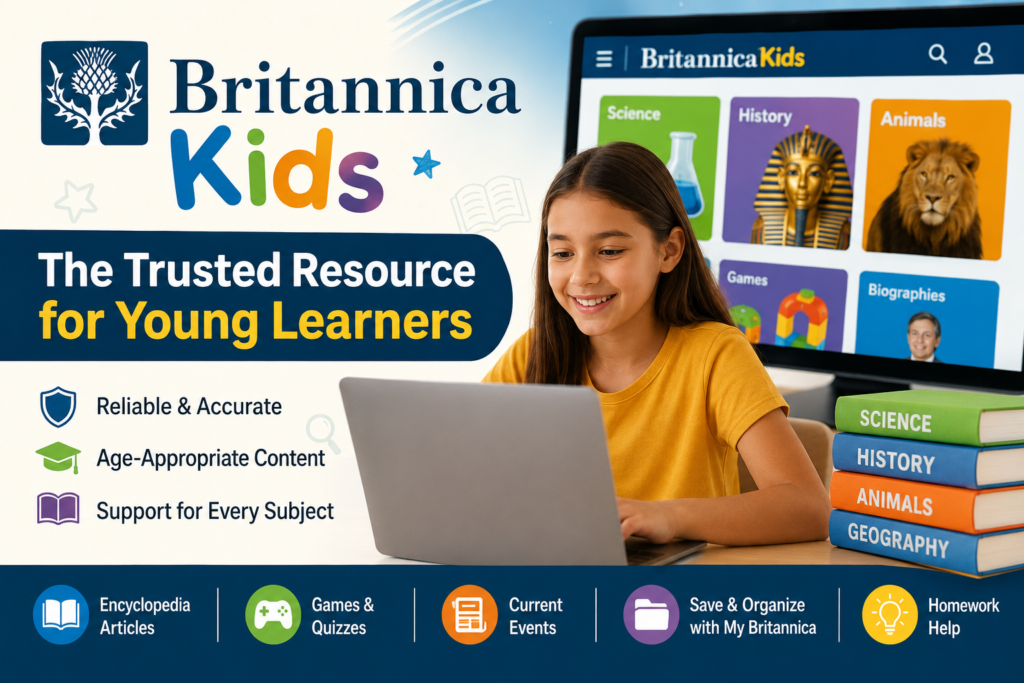
Beyond the core encyclopedia articles Britannica Kids includes a range of features that extend its usefulness for both learning and teaching. The platform includes games quizzes and interactive activities tied to specific subject areas which gives younger students a way to engage with content that does not require sustained reading attention. For early learners especially the ability to reinforce information through a short interactive activity can make a real difference in retention.
The platform also includes a homework help section current events coverage written at age-appropriate reading levels and a feature called My Britannica that allows students to save articles create folders and organize their research. These tools encourage students to approach research as an organized process rather than a series of disconnected searches which is a habit that pays off significantly as academic demands increase in later grades. Britannica Kids is designed to grow with the student and these organizational features are part of how it does that.
Britannica Kids vs. Wikipedia for Young Learners
The comparison between Britannica Kids and Wikipedia comes up constantly among parents and teachers and it is worth addressing directly. Wikipedia is a remarkable resource in many contexts but it is not designed for children and it carries real limitations as a primary source for student research. Its open-editing model means content quality varies significantly from article to article and the reading level is inconsistent some entries are accessible to a general audience while others assume significant background knowledge.
Britannica Kids solves both of those problems by design. The content is written for specific age groups and maintained by professional editors which means the accuracy and accessibility are consistent across the platform rather than variable. For elementary and middle school students who are still developing their ability to evaluate information critically that consistency matters. Wikipedia has its place in research particularly as a starting point for finding primary sources via its reference lists but as a direct reference for young students Britannica Kids offers a more appropriate and more reliable alternative.
Subscription Options and Access for Families
Britannica Kids is available through individual family subscriptions as well as institutional licenses for schools and libraries. For families the subscription gives access to all three content levels making it practical for households with children in different grades. The pricing is straightforward and positions the platform competitively against other educational subscription services particularly given the depth and quality of the content it provides.
Many public libraries in the United States provide free access to Britannica Kids through their digital resource programs which means families with library cards can often access the platform at no cost simply by logging in through their library’s website. This is worth checking before purchasing a family subscription as library access is frequently underutilized simply because families are unaware it exists. Teachers can also direct students to check for school-provided access which is available in a large number of districts across the country.
Using Britannica Kids for Homeschool Curricula
For homeschooling families Britannica Kids functions as a reliable anchor for research and reference across multiple subject areas. It covers the range of topics that appear in standard K-8 curricula earth science life science American history world geography biographies of historical figures and more with content that is accurate clearly written and appropriate for the age groups being taught. Having a single trusted reference platform simplifies lesson planning and gives students a consistent resource they can return to independently.
The platform also supports the kind of self-directed learning that homeschool environments often prioritize. A student who finishes a unit on ancient Egypt and wants to explore further has immediate access to related articles timeline features and multimedia content within Britannica Kids without needing to navigate the open internet. That contained curated environment is particularly valuable for younger homeschool students who are not yet equipped to evaluate search results on their own and need the guardrails of a vetted platform while they develop those skills.
How to Get the Most Out of Britannica Kids
Using Britannica Kids effectively comes down to treating it as a starting point rather than the only point. Students who read an article on a topic take notes and then pursue more specific questions through additional sources are developing the research skills that will serve them throughout their academic careers. Parents and teachers can support this process by asking students to identify two or three questions that the Britannica Kids article raised but did not fully answer and then working together to find those answers elsewhere.
For younger students the interactive features and games are worth exploring alongside the articles rather than treating them as separate activities. When a child reads about ecosystems and then plays a game that tests their knowledge of food chains the two activities reinforce each other in a way that straightforward reading alone does not. The platform is built to be used comprehensively and students who engage with multiple features rather than just the article text will get considerably more out of their time on it. That approach works for classroom use and home use equally.
Conclusion
Britannica Kids delivers something that is genuinely hard to find in the current online landscape accurate age-appropriate professionally edited information that children can use independently and teachers can trust completely. The tiered content levels the breadth of subject coverage the editorial standards and the additional features that support research organization and active learning all add up to a platform that earns its place in both classrooms and homes.
The name Britannica carries more than two hundred and fifty years of editorial credibility and that credibility extends fully into the children’s platform. In an environment where children are constantly exposed to information of wildly varying quality having a reliable reference they can return to consistently is not a small thing. Britannica Kids is that resource and for parents teachers and students who take learning seriously it is one of the better investments available in educational tools today.
FAQs
What age group is Britannica Kids designed for?
Britannica Kids is designed for students from kindergarten through middle school roughly ages five to fourteen. The platform is divided into three levels Kids Students and Young Adults each written for a different reading level and depth of understanding so the content is appropriate across a fairly wide age range within that span.
Is Britannica Kids free to use?
The platform requires a subscription for full access but many public libraries and school districts in the United States provide free access to Britannica Kids through institutional licenses. Families with library cards should check their local library’s digital resources page as free access is frequently available and simply underused because people do not know to look for it.
How is Britannica Kids different from the regular Encyclopaedia Britannica?
The standard Encyclopaedia Britannica is written for adult readers and assumes a level of background knowledge and reading ability that most children do not yet have. Britannica Kids uses age-appropriate vocabulary shorter articles more visual support and a tiered structure designed specifically for elementary and middle school students. The editorial standards are the same accurate professionally reviewed content but the presentation is built for younger audiences.
Can teachers use Britannica Kids in the classroom?
Yes and many do. Britannica Kids is widely used in American schools as a research resource a reading comprehension tool and a supplementary material for science and social studies units. Many school districts license the platform institutionally giving all students access through their school accounts. Teachers appreciate the consistent accuracy and the alignment with standard curriculum topics.
Is Britannica Kids appropriate for homeschool use?
Britannica Kids works well for homeschool curricula covering the range of subjects taught at the K-8 level with accurate clearly written content. It supports both structured lesson plans and self-directed learning and the platform’s contained curated environment is useful for younger students who are not yet ready to navigate the open internet independently.
How often is Britannica Kids content updated?
The platform is updated regularly particularly for content in areas that change over time such as science current events and world geography. This distinguishes it from print encyclopedias which become outdated immediately after publication. Regular updates ensure that students are working with current information rather than relying on facts that may have changed since the content was originally written.
Does Britannica Kids have features beyond encyclopedia articles?
Yes. In addition to the core encyclopedia content Britannica Kids includes games quizzes interactive activities current events coverage a homework help section and a My Britannica feature that lets students save and organize articles. These additional features support different learning styles and encourage students to engage with content more actively than straightforward reading alone allows.