


Financial contingency fund is money set aside specifically to cover unexpected costs the kind of expense that is not part of a normal budget and can not always be predicted in advance. The term is used in both personal finance and business finance and while the basic purpose is similar the way a contingency fund is sized managed and used can differ significantly depending on which one you’re building.
This guide covers both perspectives: what a financial contingency fund does for an individual or household what it does for a business how to determine how much you may need and where that money can be kept so it remains accessible when an unexpected expense arises.
Contingency Fund vs. Emergency Fund: Is There a Difference?
In personal finance “contingency fund” and “emergency fund” are often used interchangeably and for most people they mean the same thing: cash reserved for unplanned expenses like a job loss a medical bill or an urgent home or car repair.
In a business context the distinction is a little sharper. An emergency fund tends to refer to a general cash cushion for keeping the business running if revenue drops. A contingency fund is often more specific money earmarked for a particular category of risk such as a project going over budget a lawsuit a major equipment failure or a supply chain disruption. Some companies maintain both: a broad operating reserve and a narrower contingency line tied to a specific project or risk.
The terminology overlaps enough that it is worth reading context clues rather than assuming a strict definition. If a company’s project budget includes a “10% contingency line” that is different from a corporate contingency fund sitting on the balance sheet as reserved cash.
Why a Contingency Fund Matters
The value of a contingency fund is not really about the money itself it is about what having that money available prevents you from having to do. Without one an unexpected cost usually gets covered one of three ways: debt selling an asset you did not want to sell or cutting something else that mattered. All three come with a cost beyond the dollar amount of the original problem.
For a household that might mean a car repair going onto a high-interest credit card instead of coming out of savings. For a business it might mean a slow month forcing a founder to delay payroll or a manufacturer having to take on expensive short-term financing after a key supplier fails to deliver. A contingency fund does not eliminate the underlying problem but it removes the second layer of financial damage that often comes from having to react to it without cash on hand.
How Much Should a Personal Contingency Fund Hold?
The common guidance for individuals is to hold three to six months of essential living expenses rent or mortgage utilities groceries insurance minimum debt payments and other non-negotiable costs. This range is not an arbitrary number; it roughly matches how long it typically takes to find new work after a job loss plus some buffer for less common but still plausible disruptions.
Where you land within that range depends on your own risk factors:
- Single-income households generally lean toward the higher end since there is no second income to fall back on.
- Freelancers and commission-based earners often benefit from an even larger cushion sometimes six to twelve months because income is less predictable month to month.
- Dual-income households with stable employment can sometimes manage with a smaller buffer closer to three months.
- People with significant fixed obligations like a mortgage or dependents tend to need more than someone with lower fixed costs.
There’s no single “correct” number here and it’s reasonable to build the fund gradually rather than trying to hit the target amount immediately.
How Much Should a Business Contingency Fund Hold?
For businesses the calculation shifts from “months of living expenses” to “months of operating expenses” and the target range is typically similar often three to six months of fixed costs though this varies significantly by industry business model and how predictable revenue is.
A few factors that push the target higher:
- Seasonal businesses with concentrated revenue windows
- Companies with a small number of large clients where losing one client creates a meaningful revenue gap
- Businesses with high fixed costs relative to revenue such as those carrying significant lease or payroll obligations
- Early-stage startups that have not yet reached predictable revenue
Businesses with more diversified recurring revenue and lower fixed overhead can often operate with a smaller reserve relative to their size. There is not a universal formula and any specific percentage or dollar target should be treated as a starting point for internal planning rather than a fixed rule it depends heavily on the particular business’s cost structure and risk profile.
Where to Keep a Contingency Fund
The core requirement for contingency fund money is liquidity: you need to be able to access it quickly without penalties and without having to sell it at a loss during a bad moment. That generally rules out anything tied up in long-term investments real estate or accounts with early-withdrawal penalties.
Common places to hold a contingency fund include:
- High-yield savings accounts offer easy access along with some interest and are a common default choice for personal contingency funds.
- Money market accounts similar liquidity to a savings account sometimes with slightly different withdrawal terms.
- Short-term low-risk instruments for businesses such as treasury bills or short-duration deposit products when the reserve is large enough that some yield matters but liquidity still comes first.
- Separate business checking or reserve accounts kept distinct from operating cash so the money isn’t accidentally spent on day-to-day expenses.
The right home for the money depends on how quickly it might need to be accessed. A fund meant to cover a sudden emergency should prioritize same-day or next-day access over a marginally better interest rate.
Building a Contingency Fund Without Straining Your Budget
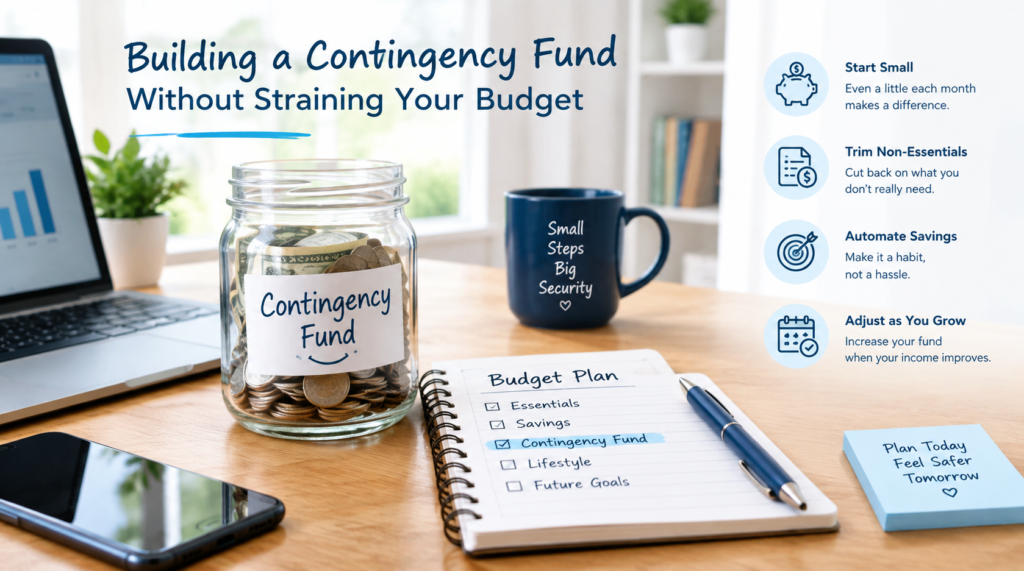
For individuals the most sustainable approach is usually automating a fixed transfer into a separate account each pay period rather than trying to save whatever is “left over” at the end of the month which tends to leave the fund undersupplied. Starting with a smaller milestone such as one month of expenses and building from there tends to be more achievable than aiming straight for six months.
For businesses contingency funds are often built by setting aside a fixed percentage of monthly revenue or profit until the target reserve is reached then maintaining that balance going forward. Some businesses tie contributions to specific triggers such as directing a portion of any unusually strong month’s revenue into the reserve rather than spending it elsewhere.
In both cases the fund works best when it is kept genuinely separate from spending accounts not necessarily a different bank but a distinct account that is not the one used for routine transactions. That separation reduces the temptation to dip into it for non-emergencies.
What Counts as a Legitimate Use of the Fund
A contingency fund tends to lose its purpose if the definition of “emergency” quietly expands over time. For individuals legitimate uses typically include job loss medical expenses urgent home or vehicle repairs and essential travel tied to a family emergency. It generally doesn’t include planned expenses like holidays predictable annual costs like car insurance renewals or discretionary purchases those are better handled through separate dedicated savings.
For businesses legitimate triggers usually include a genuine revenue shortfall a major unplanned expense tied to keeping operations running or a specific risk the fund was created to cover such as a legal dispute or a critical equipment failure. Using the fund for planned investments marketing pushes or growth initiatives defeats its purpose even if those uses feel urgent in the moment that kind of spending belongs in a separate budget line.
A Quick Way to Check If Your Financial Contingency Fund Is the Right Size
Rather than focusing on a single target amount it is helpful to evaluate whether your financial contingency fund can realistically support you or your business during an unexpected financial setback. Start by considering how long you could continue covering essential expenses or operating costs if your income suddenly stopped and whether that period would give you enough time to replace your income or restore normal cash flow. You should also consider how accessible your financial contingency fund is since money tied up in long-term investments or accounts with withdrawal restrictions may not be available when you need it most. If your current fund would leave you struggling to cover essential costs during a period of reduced income or an unexpected expense that may indicate that your reserve needs to be increased. Rather than comparing your savings with a generic benchmark focus on your own expenses income stability financial obligations and how quickly you could access the money when an unexpected situation occurs.
The Bottom Line
A financial contingency fund is less about hitting a specific number and more about creating a buffer that keeps a temporary problem from turning into a longer-term financial setback. For individuals that usually means three to six months of essential expenses held somewhere liquid. For businesses it means a reserve sized to the company’s specific revenue stability and fixed costs kept separate from day-to-day operating cash. The right size will always be somewhat personal or business-specific the goal is simply to have enough set aside that an unexpected cost becomes an inconvenience rather than a crisis.
FAQs
Is a financial contingency fund the same as an emergency fund?
In personal finance a financial contingency fund and an emergency fund are often used interchangeably. In business finance however a financial contingency fund may be set aside for a specific risk or project while an emergency fund generally provides a broader reserve for unexpected operating needs.
How much should I have in a financial contingency fund if I’m self-employed?
Many self-employed individuals aim for a larger financial contingency fund than the standard three-to-six-month guideline often saving enough to cover six to twelve months of expenses. This is because self-employed income can be less predictable than a salaried job.
Should a financial contingency fund be invested for growth?
Generally no. A financial contingency fund should remain accessible on short notice and protected from significant market losses. It is typically kept in liquid low-risk accounts rather than invested in the market so the money is available when an unexpected expense arises.
Can a small business survive without a financial contingency fund?
A small business can survive without a financial contingency fund but an unexpected expense or period of slow revenue may force the business to take on debt delay payments or make cuts elsewhere. Maintaining a financial contingency fund can help reduce the financial impact of these unexpected challenges.
How often should I revisit the size of my financial contingency fund?
It is worth reviewing your financial contingency fund whenever your expenses income stability or business cost structure changes significantly. For individuals this may happen after a move a new dependent or a job change. For businesses review the fund after major changes in revenue headcount or fixed costs.