


Gating fund is a fund that has activated or has the contractual right to activate a gate: a limit on how much money investors can pull out during a given redemption period. Instead of paying every investor everything they ask to withdraw the fund caps total outflows at a set percentage of its net asset value typically per month or per quarter and pays out requests on a pro-rata basis until that cap is reached. The rest of each request rolls over and waits for the next window.
This is a real well-established mechanism used across hedge funds private credit vehicles non-traded real estate trusts and some open-ended property and equity funds and it shows up in the news whenever a large fund hits its limit during a period of heavy investor withdrawals. Understanding how a gate works why managers use it and what it means if you already hold shares in a gated fund is genuinely useful for anyone with money in or considering money in this type of investment.
How a redemption gate actually works
A gating fund includes redemption limits in its governing documents before investors commit their money. These limits known as redemption gates specify how much investors can withdraw during a given period. The fund’s prospectus or offering memorandum may set a threshold of two percent of net asset value per month or five percent per quarter. If total redemption requests exceed that threshold the fund can activate its gate. When requests remain below the limit investors are typically paid in full according to the normal redemption schedule.
Once a gating fund activates its redemption gate it does not necessarily stop processing withdrawals. Instead it pays out as much of the total redemption demand as the cap allows and distributes the available amount among investors on a pro-rata basis. For example if investors collectively request withdrawals equal to four percent of the fund’s net asset value but the redemption limit is two percent, each investor may receive approximately half of their requested amount.
The remaining unpaid portion typically carries forward to the next redemption window where it is combined with any new withdrawal requests and processed subject to the same limit. As a result investors may need to wait through several redemption cycles before receiving their full investment back especially when new withdrawal requests continue to exceed the gating fund’s ability to raise cash.
Gating versus full suspension
Understanding the difference between a gating fund and a full suspension of redemptions is important for investors evaluating fund liquidity. Although both mechanisms restrict access to invested capital they operate differently. A gating fund limits withdrawals to a specified percentage of its net asset value while continuing normal operations. Investors generally retain their economic rights including exposure to performance and distributions and the fund can continue managing its portfolio.
A full suspension is more restrictive. Instead of allowing partial withdrawals the fund temporarily stops processing redemption requests altogether. This may happen when the mismatch between investor withdrawal demand and the liquidity of the underlying assets becomes serious enough that even limited payouts could force the fund to sell investments at unfavorable prices.
Funds built around semi-liquid strategies including private credit vehicles and non-traded real estate trusts often include gating provisions from the outset. These funds are designed to offer periodic liquidity while investing in assets that cannot always be sold quickly. A redemption gate can therefore be an expected part of the fund’s structure during periods of heavy withdrawal demand.
Full suspensions are generally associated with more severe liquidity pressures particularly when a fund lacks sufficient cash reserves or faces difficulty selling its underlying assets. While a gate allows the fund to manage withdrawals over time a suspension may indicate that the liquidity mismatch requires a more significant response.
Why fund managers use gates
The core reason funds gate redemptions is a mismatch between how quickly investors can ask for their money back and how quickly the fund’s underlying assets can actually be sold. A fund holding private loans unlisted real estate or other illiquid assets cannot convert those holdings into cash on short notice without accepting a discount and if it tried to sell enough assets to meet a sudden wave of redemption requests it would likely have to sell at unfavorable prices. That forced selling would reduce the value of the fund for every investor including those who chose to stay invested rather than redeem.
Gates are meant to prevent that outcome by spreading redemptions out over time giving the manager room to sell assets in an orderly way rather than in a fire sale. They also reduce the incentive for investors to rush to redeem purely out of fear that others will get their money out first since a gate applies the same proportional limit to everyone regardless of when their request was submitted within a given window. Industry commentary generally frames a well-designed and consistently applied gate as a routine liquidity-management tool rather than a sign that a fund is failing though a gate that stays active for many consecutive periods is still a meaningful signal that investor demand to exit has outpaced the fund’s ability to raise cash.
Where gating shows up most often
A gating fund is most commonly found in investment structures designed to hold illiquid assets. Private credit funds and non-traded business development companies for example lend directly to businesses rather than trading primarily in public markets. Because these loans can be difficult to sell quickly such funds often offer investors limited liquidity through scheduled redemption windows.
Non-traded real estate investment trusts (REITs) operate under similar constraints. Commercial properties can take considerable time to sell and a rushed sale may require accepting a significant discount. Redemption gates help these funds manage withdrawal requests without forcing the sale of valuable assets at unfavorable prices.
Traditional hedge funds have also used redemption gates for decades particularly those pursuing less liquid investment strategies. Interval funds provide another example offering scheduled repurchase opportunities rather than continuous daily redemptions. These arrangements can function similarly to a gating fund by limiting how much capital investors can withdraw during each period.
Gates are less common in mainstream open-ended mutual funds and UCITS funds which generally aim to provide daily liquidity. However these funds may still face redemption restrictions when they hold substantial positions in harder-to-sell assets such as unlisted companies, concentrated small-cap investments or property holdings. In such cases a full suspension of dealing may be more likely than a partial gate especially when the fund was not originally designed with redemption limits.
Real-world examples worth knowing
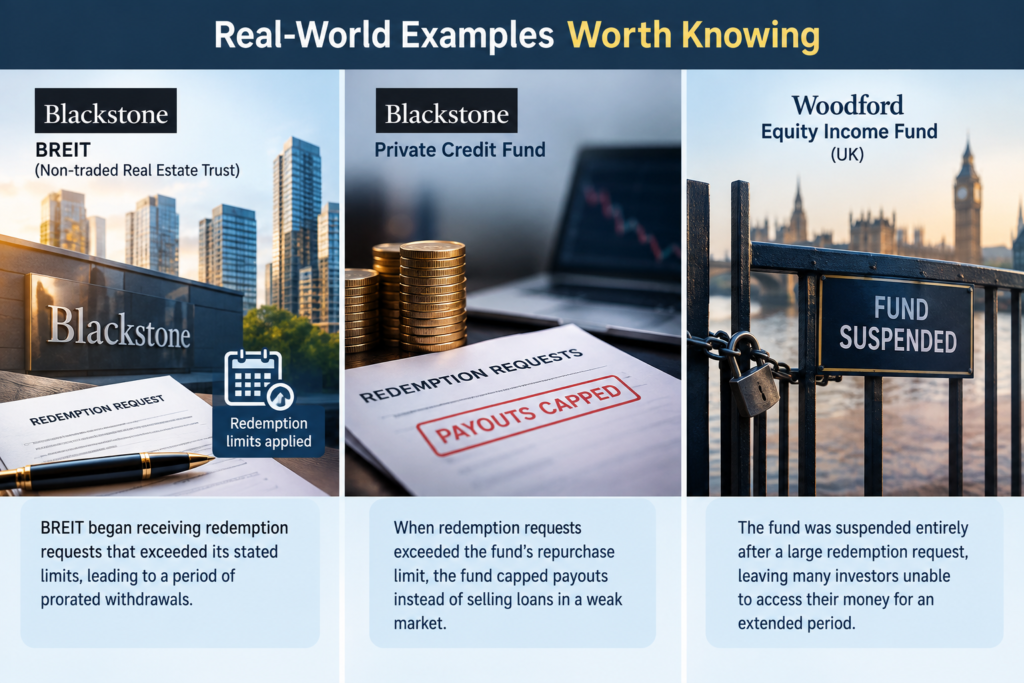
Blackstone’s non-traded real estate trust known as BREIT is probably the most widely reported gating case of the past several years. Starting in November 2022 BREIT began receiving redemption requests that exceeded its stated limits of two percent of net asset value per month and five percent per quarter and it spent more than a year prorating withdrawals as a result only lifting the limit once monthly redemption demand fell back below the threshold. Blackstone’s private credit fund faced a comparable situation later when redemption requests exceeded the vehicle’s repurchase limit and the fund capped payouts rather than selling loans into a weak market to meet every request in full.
A different kind of case is the Woodford Equity Income Fund in the UK which was suspended entirely in June 2019 after a large institutional redemption request exposed how much of the fund had drifted into unlisted and hard-to-sell holdings. Unlike BREIT’s gate this was a full suspension rather than a partial cap and it left roughly 300000 retail investors unable to access their money for an extended period while the fund was gradually wound down. The UK’s Financial Conduct Authority later fined both the fund’s manager and his firm for failing to manage the fund’s liquidity appropriately underscoring that a liquidity mismatch of this scale is treated as a genuine regulatory failing rather than routine market behavior.
What it means if you are already invested in a gated fund
If a gating fund activates a redemption gate your shares generally remain invested and continue reflecting gains losses and distributions. However accessing your money may take longer than expected. Partially fulfilled redemption requests typically carry forward, but confirm the process with your fund administrator or financial adviser.
During the gated period, the value of your investment can still rise or fall with the fund’s performance. A gate limits withdrawals not the underlying investment risk so your capital is not guaranteed to retain its original value.
Some gating funds may have a secondary market where investors can sell their shares. These sales often occur below the fund’s stated net asset value because buyers account for limited liquidity and uncertainty about when the gate will end. Selling may provide faster access to cash, but it can also mean accepting a discount on your investment.
How to weigh gating risk before you invest
Before investing in a gating fund review its redemption terms gate thresholds withdrawal windows and history during market stress. Understand how quickly you can access your money and whether the fund’s liquidity matches your financial needs.
Because gating funds may invest in illiquid assets, only allocate money you can afford to leave invested for an extended period. These funds can offer exposure to potentially higher-yielding investments but they are not a substitute for cash savings or emergency funds.
Final thought
A gating fund is not automatically a warning sign since many private credit real estate and hedge fund structures are built around this mechanism from day one and disclose it clearly before anyone invests. What matters is understanding the difference between a routine well-managed gate and a liquidity mismatch that a fund was never properly designed to handle and making sure any allocation to this type of fund reflects money you can genuinely afford to have tied up for an extended period if redemption demand ever exceeds what the fund can pay out on schedule.
FAQs
What Is the Difference Between a Gate and a Lockup Period?
A gating fund may use a redemption gate to limit how much investors can withdraw during a specific redemption window. A lockup period by contrast prevents investors from redeeming their shares for a set period after investing regardless of market conditions. While a lockup restricts withdrawals during the initial investment period a redemption gate can apply even after the lockup has ended limiting the amount investors can withdraw when redemption requests exceed the fund’s stated threshold.
Does gating mean a fund has lost money?
Not necessarily. A gating fund may limit withdrawals because investor demand exceeds its available liquidity even when the underlying investments are performing well.
How long can a gate stay active?
A gating fund can keep its redemption gate active for as long as withdrawal demand exceeds its liquidity. In some cases gates remain active for over a year before normal redemptions resume.
Can a fund gating activate a gate without warning?
A gating fund discloses its redemption limits in the offering documents before investors commit money. When activated, the gate is typically announced through a shareholder letter after redemption requests exceed the stated threshold.
Does a gating funds investment still earn returns?
Generally yes. A gating fund limits withdrawals but your investment typically continues to reflect gains losses and distributions while the gate is active.
Should I avoid funds that have gating provisions?
Not necessarily. Before investing in a gating fund review its redemption limits and history and only invest money you can afford to leave invested for an extended period. This is general information not personalized financial advice.