

Introduction
Before the silk robe before the mansion before Playboy became a household name across the world there was a quiet kid from Chicago with a strict upbringing and an imagination that had nowhere comfortable to go. Hugh Hefner young is a story that does not get told nearly as often as the later chapters the parties the fame the controversies but it is the part that explains everything that came after. Understanding where he started makes the trajectory of his life considerably more interesting and considerably more complicated.
Hefner grew up in a household that did not discuss emotions did not encourage excess and did not leave much room for the kind of dreaming he was already doing by the time he was a teenager. The tension between that environment and what he eventually built is the central thread of his early life. He was not born into the world he eventually created. He constructed it from scratch starting with almost nothing driven by a set of ideas about freedom and culture and masculinity that he had been turning over in his mind since he was old enough to read a magazine.
Childhood in Chicago and the Roots of Rebellion
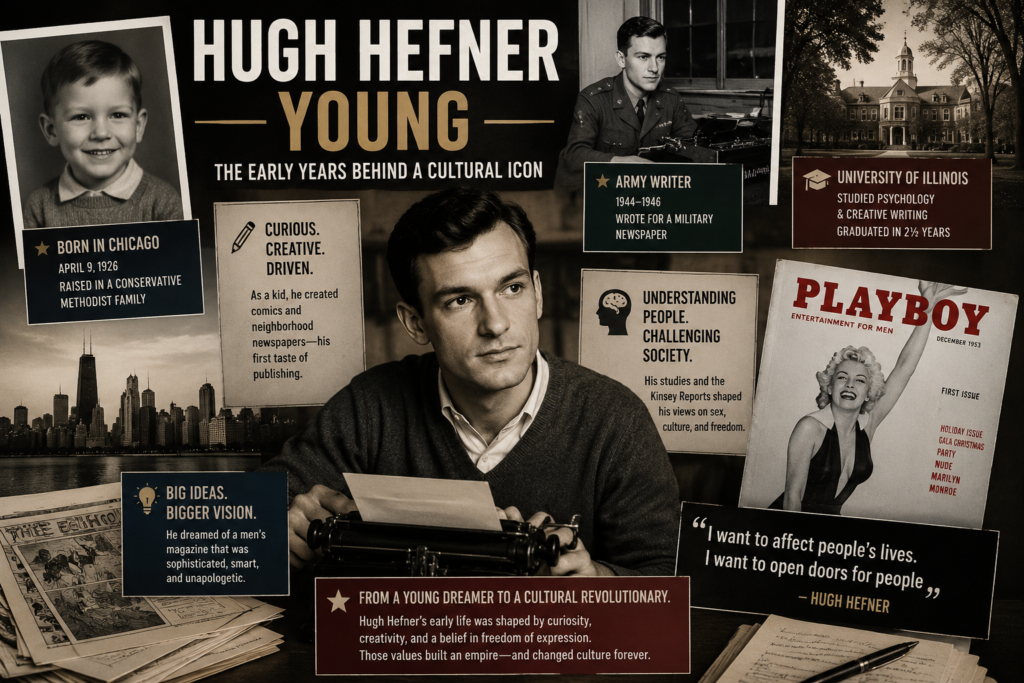
Hugh Marston Hefner was born on April 9 1926 in Chicago Illinois to Glenn and Grace Hefner. His parents were both descendants of early American settlers and were devout Methodists who ran a household that was orderly emotionally reserved and deeply conservative by any reasonable measure. Hefner would later say that his parents almost never expressed affection openly that love in his home was implied rather than demonstrated and that the atmosphere shaped him in ways he spent the rest of his life reacting against.
That reaction did not take the form of rebellion in the conventional teenage sense. Hugh Hefner young was not a troublemaker or a dropout. He was a good student socially active and already showing the entrepreneurial instincts that would define his adult life. He created hand-drawn comic books and neighborhood newspapers as a child charging other kids to read them. The impulse to publish to create a platform to put ideas in front of an audience it was already there before he had any real tools or resources to act on it. Chicago gave him the backdrop. His upbringing gave him the motivation.
Academic Years and Early Creative Ambitions
Hefner attended Steinmetz High School in Chicago where he was by all accounts a socially engaged and creatively active student. He edited the school newspaper contributed cartoons and generally gravitated toward any activity that involved communication and audience. These were not the activities of someone drifting without direction. They were the early expressions of a very specific set of interests that would eventually find their fullest outlet in Playboy magazine.
After high school Hugh Hefner young served briefly in the U.S. Army between 1944 and 1946 working as a writer for a military newspaper again gravitating toward the page even in an institutional setting. After his discharge he enrolled at the University of Illinois at Urbana-Champaign where he studied psychology and graduated in just two and a half years with a degree and a minor in creative writing. He was already operating with urgency already moving faster than the standard timeline already convinced that he had somewhere specific to be and not much time to waste getting there.
The Psychology Degree and What He Actually Learned From It
Hefner’s choice to study psychology was not incidental. He was genuinely interested in human behavior in what motivated people in what society permitted and what it suppressed. Those questions would become the intellectual spine of Playboy’s early editorial voice the idea that American culture in the postwar period was unnecessarily repressive about sex and pleasure and that a publication could challenge that repression while still being sophisticated and culturally serious.
The academic grounding gave Hugh Hefner young a framework for arguments he was already making intuitively. He understood marketing and human desire not just as instincts but as things that could be analyzed and acted upon deliberately. His senior thesis at the University of Illinois examined American sex laws and their relationship to the Kinsey Reports which had just been published and were causing considerable controversy across the country. The thesis was essentially a rehearsal for the editorial philosophy he would publish at scale just a few years later.
Early Career Struggles and the Path to Publishing
After graduating Hefner tried to build a career in the conventional publishing world and found it slow and frustrating. He worked briefly at the Chicago Cartoon Company then took a job in the promotions department at Esquire magazine a position that put him directly in contact with the kind of publication he eventually wanted to create and made clear how far he still had to go. When he asked for a five dollar raise and was turned down he quit and decided he would build something himself.
That decision made by Hugh Hefner young in his mid-twenties with minimal savings and no guaranteed path forward is the pivot point of his entire story. He spent the next couple of years working other jobs and developing the concept for a men’s magazine that would be smarter more culturally ambitious and more honest about sexuality than anything currently on the market. He was not reckless about it he researched he planned he talked to people in the industry but he was operating on conviction more than certainty which is usually how things like Playboy get started.
The Influence of Kinsey and Sexual Politics in Postwar America
The publication of Alfred Kinsey’s Sexual Behavior in the Human Male in 1948 was a cultural earthquake and the young Hugh Hefner felt the tremors immediately. Kinsey’s research documented with statistical rigor how much of what American society considered deviant or rare sexual behavior was actually widespread and common. The gap between what people actually did and what they were permitted to acknowledge publicly was enormous and Kinsey made that gap visible in a way that could not easily be dismissed.
For Hugh Hefner young already working on his thesis about sex laws and deeply interested in the distance between American ideals and American reality Kinsey was confirmation that the conversation he wanted to have was both necessary and timely. The postwar period was economically prosperous and culturally conservative in ways that felt increasingly artificial to a generation of men who had just been through the war. Hefner read that tension clearly and built his entire publishing concept on the idea that there was a large educated urban male audience that wanted something more honest and more fun than what mainstream media was offering them.
Founding Playboy: What the Young Hefner Actually Built
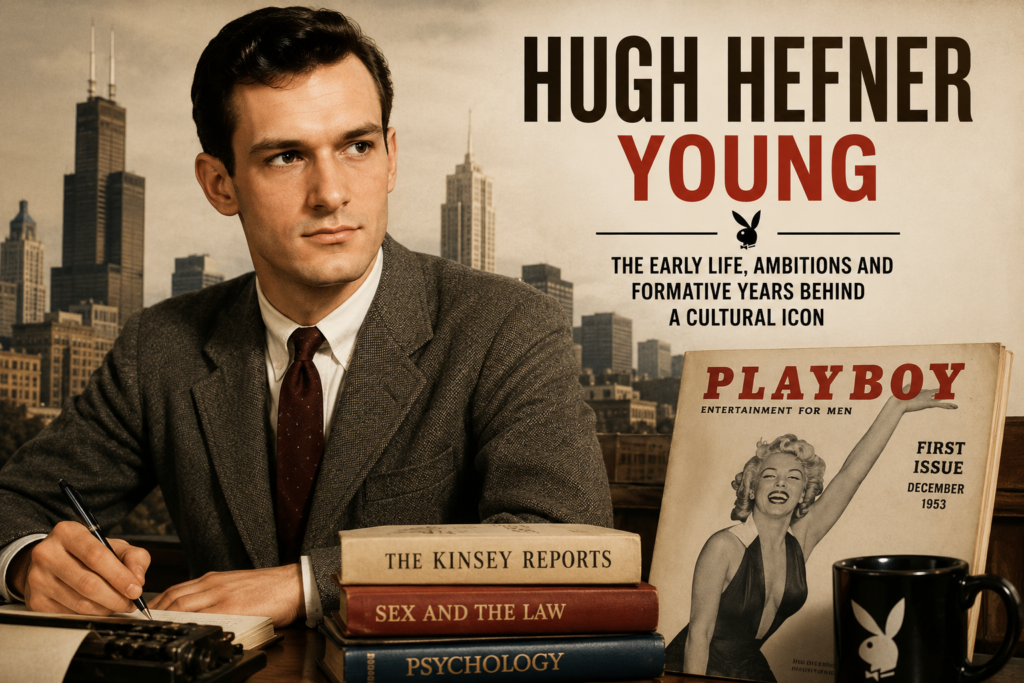
In 1953 with roughly eight thousand dollars raised from investors including a loan from his mother Hefner launched the first issue of Playboy from his Chicago apartment. He was twenty-seven years old. The first issue featured Marilyn Monroe in photographs taken before Hefner had any connection to her he purchased the rights from a calendar company and it sold over fifty thousand copies. For a first issue of an unknown magazine with no distribution guarantee that number was remarkable.
What Hugh Hefner young built with that first issue was not just a successful magazine launch. It was a proof of concept for an entire editorial philosophy. Playboy from the beginning combined nude photography with serious fiction cultural commentary and interviews with significant figures in politics and the arts. The combination was deliberate Hefner wanted the magazine to be taken seriously as a cultural voice not dismissed as simple pornography. The sophistication was part of the argument he was making about what adult men were actually interested in and capable of engaging with.
Personal Life and the Contradictions of the Young Hefner
Hefner married Mildred Williams in 1949 a woman he had dated through his college years and who he admitted he felt pressured to marry after she told him she had been with someone else while he was in the army. By his own account the marriage was not a great fit from the beginning driven more by circumstance than genuine compatibility. They had two children together Christie and David before divorcing in 1959. The marriage ran roughly parallel to the founding and early success of Playboy which meant Hefner was building his public empire around ideals of bachelor freedom while living a fairly conventional domestic life at home.
That contradiction is worth sitting with because it reveals something honest about Hugh Hefner young that the later mythology tends to smooth over. The Playboy philosophy was partly genuine conviction and partly a projection of the life he wanted but did not yet have. The mansion the parties the lifestyle that became his public identity those came later after Playboy was already successful after the marriage ended after he had the resources to actually live the way he had been writing about. The young Hefner was in many ways building a world for the older Hefner to inhabit.
The Chicago That Shaped His Aesthetic
Chicago in the postwar decades was a genuinely interesting cultural environment and it left clear marks on Hefner’s sensibilities. The city had a strong jazz scene a sophisticated restaurant culture and a particular kind of urban masculinity cosmopolitan but not precious interested in pleasure but not frivolous about it. These were exactly the qualities Hefner tried to project through Playboy’s early identity and they came directly from the environment he grew up in and chose to stay in when he could have moved to New York or Los Angeles.
Hugh Hefner young absorbed Chicago’s particular cultural confidence and built it into the magazine’s DNA. Playboy was always a Chicago product in ways that went beyond its mailing address. The editorial voice had a Midwestern directness underneath its sophistication a quality that distinguished it from East Coast publications and may have been part of why it connected so broadly across the country rather than just in major coastal cities. Hefner understood his own context and used it which is a skill that is rarer than it sounds.
What the Early Years Reveal About the Man He Became
Looking at Hugh Hefner young the shy kid from a repressive household the fast-moving student the frustrated employee who decided to bet on himself you see a person whose adult life was a sustained argument against the world he came from. Almost every major decision he made from the editorial philosophy of Playboy to the way he constructed his personal life and public image can be traced back to specific things he experienced or felt during those early years in Chicago.
That does not make the later chapters simple or uncomplicated. Hefner became one of the most controversial figures in American cultural history and the debates around his legacy are legitimate and ongoing. But they are easier to engage with honestly when you understand where he started. The early life does not excuse everything that came later but it explains a great deal of it the obsessions the contradictions the relentless drive to construct an alternative to the world he grew up in even when that alternative had serious problems of its own.
Conclusion
Hugh Hefner young was a product of his time and his circumstances in ways that shaped everything he eventually became. A conservative Chicago upbringing a sharp mind that found its outlet in publishing and ideas a frustration with postwar American repressiveness and a willingness to put his own money and credibility behind a concept that most people in the industry thought was either too risky or too crude these were the ingredients that produced Playboy and the cultural phenomenon that surrounded it.
His early years matter because they are where the actual thinking happened. By the time the first issue of Playboy hit newsstands in 1953 Hefner had already spent years working out the ideas that would define it. The mansion and the silk robe came later. The foundation was built by a young man in Chicago with a psychology degree a thesis about sex laws and a very clear sense of the world he wanted to create.
FAQs
Where was Hugh Hefner born and raised?
Hugh Hefner was born on April 9 1926 in Chicago Illinois. He grew up in a conservative Methodist household and spent most of his early life in Chicago which remained his base when he launched Playboy in 1953.
What did Hugh Hefner study in college?
Hefner studied psychology at the University of Illinois at Urbana-Champaign where he also minored in creative writing. He completed his degree in two and a half years. His senior thesis examined American sex laws in relation to the Kinsey Reports which directly foreshadowed the editorial philosophy he would bring to Playboy.
Did Hugh Hefner serve in the military?
Yes. Hefner served in the U.S. Army from 1944 to 1946 after finishing high school. During his service he worked as a writer for a military newspaper which was consistent with the publishing and communication interests he had shown since childhood.
How old was Hugh Hefner when he started Playboy?
Hefner was twenty-seven years old when the first issue of Playboy was published in December 1953. He funded the launch with approximately eight thousand dollars raised from investors and a personal loan from his mother and he produced the first issue from his Chicago apartment.
Was Hugh Hefner married when he started Playboy?
Yes. Hefner was married to Mildred Williams from 1949 until their divorce in 1959. They had two children together. The marriage overlapped with the founding and early growth of Playboy a period during which Hefner was publicly promoting a bachelor lifestyle he was not personally living at the time.
What jobs did Hugh Hefner have before starting Playboy?
After college Hefner worked at the Chicago Cartoon Company and then in the promotions department at Esquire magazine. His experience at Esquire gave him direct insight into the magazine industry and after being denied a small raise motivated him to leave and build his own publication.
How did Hugh Hefner’s upbringing influence Playboy?
Hefner grew up in a household that was emotionally reserved and socially conservative. He consistently described his childhood environment as repressive and much of the Playboy philosophy the argument that American culture was unnecessarily restrictive about pleasure and sexuality was a direct response to that upbringing. The magazine was in many ways the sustained counterargument to the world he grew up in.