


Mosque fund is a pool of donated money set aside to support a mosque’s construction renovation or ongoing operations. In practice the term covers several different things depending on context. It might refer to a one-time building fund for constructing a new masjid an ongoing operating fund that covers utilities staff salaries and maintenance or a specific project fund for something like a new prayer hall extension a school or an Islamic center attached to the mosque. Most established mosques run more than one of these funds at the same time each tracked separately.
Anyone researching this topic is usually trying to understand one of two things: how mosque funding actually works from a financial and religious standpoint or how to evaluate a specific mosque fund before donating to it. Both questions come down to the same underlying issue which is that mosques are nonprofit organizations managing public donations and like any nonprofit the way those funds are raised categorized and accounted for matters a great deal to the people supporting them.
The different types of funds a mosque manages
A building fund is usually the largest and most visible fund a mosque runs since new construction or major renovation can cost anywhere from several hundred thousand dollars to several million depending on the size of the project and the local cost of land and construction. These funds are typically raised over years rather than months often through a combination of large individual pledges community fundraising drives and ongoing smaller contributions.
An operating fund covers the recurring costs of simply running the mosque once it exists including utilities imam and staff compensation cleaning and maintenance insurance and general upkeep. This fund tends to receive less attention in fundraising campaigns than a building project but it is arguably more important for a mosque’s long-term sustainability since a completed building still needs a steady stream of income to stay open. Some mosques also maintain separate funds for specific programs such as a school a food pantry a funeral or burial assistance fund or a scholarship fund for students each with its own donation stream and reporting.
The Islamic financial principles behind mosque funding
Mosque funding is shaped by a few core concepts from Islamic finance and charity and understanding them helps explain why mosque fundraising looks somewhat different from a typical nonprofit capital campaign. Sadaqah refers to voluntary charitable giving and it is the category most mosque building and operating donations fall under since giving to support a house of worship is broadly encouraged as an act of ongoing charity sometimes described as sadaqah jariyah or continuous charity because the benefit keeps accruing to the donor as long as the mosque and its programs remain in use.
Zakat is a separate and more specific obligation a mandatory annual payment for Muslims whose wealth exceeds a set threshold and it is restricted by Islamic law to a defined set of recipient categories focused primarily on the poor the needy and several other specific groups. Whether general mosque construction qualifies as an eligible use of zakat funds is a matter of ongoing scholarly discussion and views differ across schools of thought and individual scholars so mosques that want to be careful usually keep zakat donations in a clearly separate fund from general building or operating donations rather than assuming the two can be used interchangeably. Waqf or an endowment is a third and increasingly common approach where a donor permanently dedicates an asset such as land a property or an investment so that its income supports the mosque indefinitely rather than being a one-time gift.
How mosques actually raise the money
Direct donation campaigns remain the most common method whether through in-person collection at Friday prayers pledge drives tied to major projects or ongoing donation boxes and bank transfers. Ramadan is consistently the busiest fundraising period for mosques since charitable giving is especially encouraged during this month and many Muslims plan a significant share of their annual giving around it.
Online crowdfunding platforms have become a standard tool alongside traditional collection methods letting mosques accept donations through embedded forms peer-to-peer fundraising pages and recurring giving options rather than relying solely on cash collected on-site. This has made it easier for mosques to reach donors beyond their immediate local community including diaspora communities supporting mosque construction in another country. Interest-free community loans sometimes called qard hasan are another financing tool some mosques use for larger projects where community members lend money without interest to be repaid over time as the mosque’s income allows since conventional interest-bearing loans are not compatible with Islamic finance principles. Waqf-based endowment funds membership dues at mosques that operate on a membership model and occasional grants from local government or interfaith community funds round out the remaining sources though grants of this kind tend to be limited and competitive rather than a reliable primary funding source.
Why fund management and accountability matter
Because mosques handle donations from potentially hundreds or thousands of individual contributors how that money is tracked and reported becomes a genuine governance issue rather than a minor administrative detail. Academic research into mosque fund management has specifically flagged accountability and internal control practices as an area needing real attention pointing to gaps in how some mosques document income and disbursements. This is not unique to mosques. Any nonprofit organization handling public donations faces similar risks if it does not separate duties keep clear records and provide regular reporting back to its donor base.
A well-run mosque fund typically keeps building funds operating funds and any zakat-specific funds in clearly separated accounts rather than commingling them produces regular financial updates for the community and has more than one person involved in approving and recording significant transactions. Larger mosques particularly those registered as formal nonprofits often have a board or a finance committee overseeing this process and may produce annual financial statements sometimes audited by an outside accountant especially once the mosque’s revenue crosses a threshold where more detailed financial disclosure is expected.
Tax status and what it means for donors
In the United States mosques that are organized and recognized as tax-exempt religious or charitable organizations under Internal Revenue Code section 501(c)(3) allow donors to deduct their contributions on their federal tax returns the same as donations to a church synagogue or secular charity. Many mosques register with the IRS and file the appropriate annual disclosure though very small organizations with limited annual revenue may only be required to file a simplified electronic notice rather than a full financial return which can make it harder for a prospective donor to find detailed financial information through public nonprofit databases. Similar tax-advantaged charitable status exists for registered mosques and Islamic charities in other countries such as registered charity status in the United Kingdom though the specific rules and reporting requirements vary by jurisdiction.
For a donor confirming this status before giving matters for two reasons. It affects whether the donation is tax-deductible and the registration process itself typically requires at least some baseline level of organizational and financial disclosure which offers a small but meaningful layer of accountability compared with giving to an informal unregistered collection effort.
What to check before donating to a mosque fund
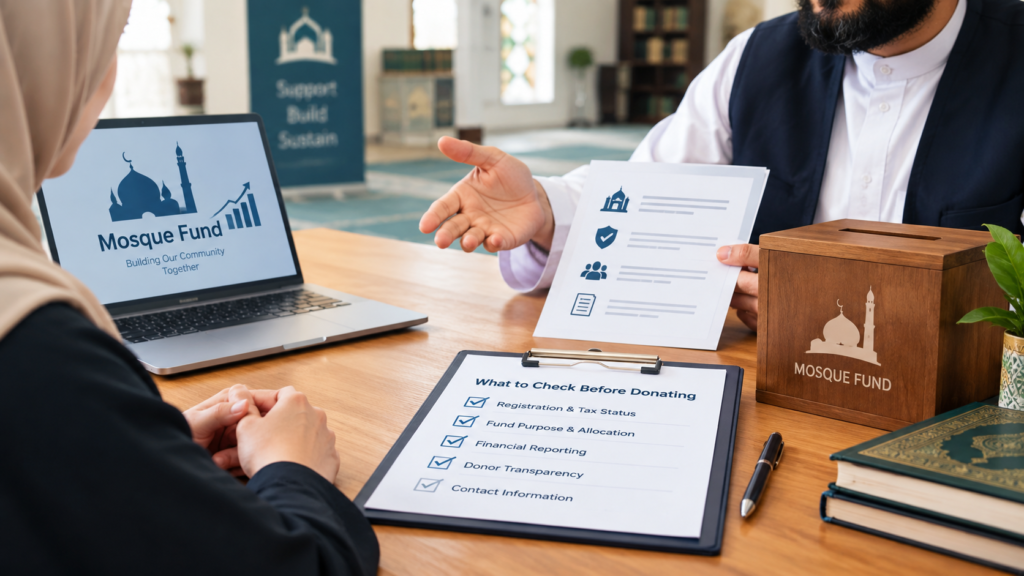
Before contributing to a mosque building campaign or an online mosque fundraiser it is worth confirming a few basic things. Check whether the organization is formally registered as a nonprofit or charity in its jurisdiction and look for its registration number or tax-exempt status where that information is typically disclosed on official communications or its website. Ask or look for public information about how funds are separated by purpose particularly if you specifically want your donation to go toward zakat-eligible uses rather than general sadaqah since these should not be treated as interchangeable.
It is also reasonable to ask a mosque committee directly how regularly they report on fund usage to the community and whether financial statements are available for review especially for a large capital campaign. A mosque with an established track record of transparent reporting is generally a safer bet for a significant donation than a newly formed campaign with limited public information though a lack of established history does not automatically mean a project is untrustworthy particularly for smaller or newly formed communities still building out formal governance structures.
Final Thought
A mosque fund is ultimately a community finance question as much as a religious one. Getting a building constructed or an operating budget covered depends on the same fundamentals that any nonprofit fundraising effort depends on: clear categorization of what each donation is for disciplined financial management once the money comes in and honest reporting back to the people who gave it. Understanding the distinction between sadaqah zakat and waqf and knowing what to look for in how a mosque manages its funds helps both mosque committees running a campaign and donors deciding where to give with confidence.
FAQs
Can zakat be used to build a mosque?
This is genuinely debated among Islamic scholars since zakat is restricted to specific recipient categories focused mainly on the poor and needy and views differ on whether general mosque construction qualifies. Many mosques keep zakat donations in a separate fund from general building donations for this reason and donors with specific questions should consult a knowledgeable scholar.
What is the difference between sadaqah and zakat in mosque fundraising?
Zakat is a mandatory annual payment restricted to defined categories of recipients while sadaqah is voluntary charitable giving with fewer restrictions on its use. Most general mosque building and operating donations fall under sadaqah rather than zakat.
Are donations to a mosque fund tax-deductible?
Donations to a mosque fund may be tax-deductible depending on the country and the mosque’s legal status. In the United States contributions are generally tax-deductible when the mosque or its supporting organization is recognized by the IRS as a 501(c)(3) tax-exempt organization. Similar deductions may be available in other countries when the mosque fund is operated by a registered or recognized charity, although specific tax rules vary by jurisdiction.
How can I verify a mosque fundraiser is legitimate before donating?
Check whether the organization is formally registered as a nonprofit or charity look for its registration or tax-exempt number and ask about how regularly it reports on fund usage to donors. Established mosques with a track record of public financial reporting generally offer more transparency than newly formed informal campaigns.
What is a waqf and how does it relate to mosque funding?
A waqf is a permanent charitable endowment where a donor dedicates an asset such as property or investments so that its ongoing income supports the mosque indefinitely rather than making a single one-time donation.