

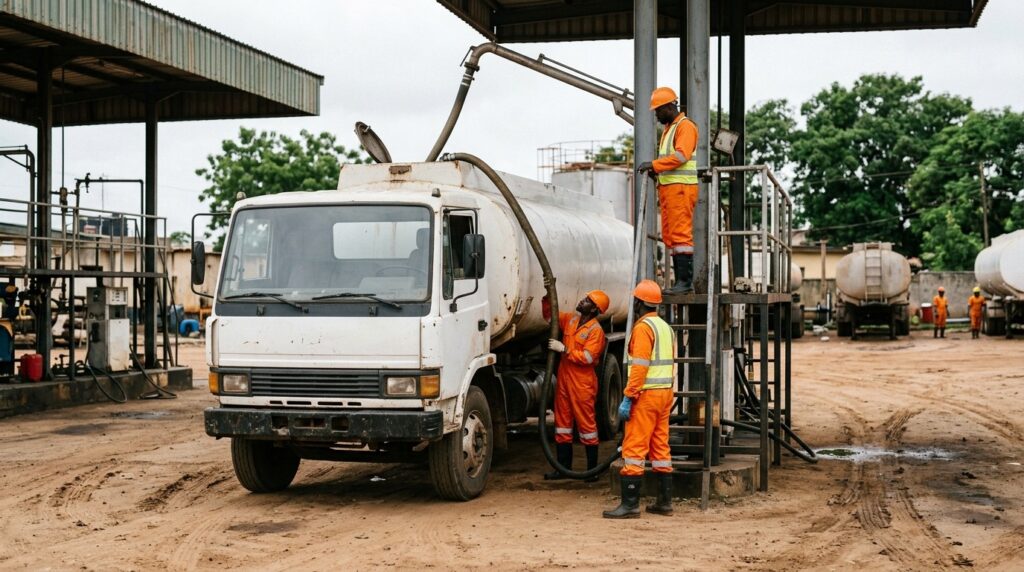
Petroleum Equalisation Fund (PEF) commonly known as the PEF was a Nigerian government scheme designed to keep the prices of petrol diesel and kerosene broadly equal across the country regardless of how far a filling station was from a refinery or import terminal. For nearly five decades the fund played a central though often controversial role in Nigeria’s downstream petroleum sector.
Following the removal of the petrol subsidy in 2023 the PEF’s core equalisation function largely stopped operating and the fund has since been widely described as defunct. However as with many changes in Nigeria’s petroleum sector its current legal and institutional status is more nuanced than that label alone suggests.
This article explains what the Petroleum Equalisation Fund was created to do how its price-equalisation system worked why it faced persistent criticism and what happened to the fund after Nigeria’s fuel-subsidy reforms.
Why the PEF Was Created
Nigeria set up the Petroleum Equalisation Fund in 1975 under Decree Number 9 later amended and consolidated into what became Chapter 352 of the Laws of the Federation. The problem it was designed to solve was straightforward: refineries and import terminals are concentrated in a handful of locations but fuel needs to be sold at a consistent price everywhere in the country from Lagos to remote towns hundreds of kilometers from the nearest depot.
Without some kind of intervention transporting fuel over longer distances would naturally cost more and that cost would either get passed on to consumers in far-flung areas or absorbed by marketers as a loss. The PEF was the government’s answer: a fund that reimbursed oil marketing companies for the additional transportation costs or “bridging” costs they incurred moving petroleum products from depots to filling stations so that pump prices could stay uniform nationwide.
How the Petroleum Equalisation Fund Actually Worked
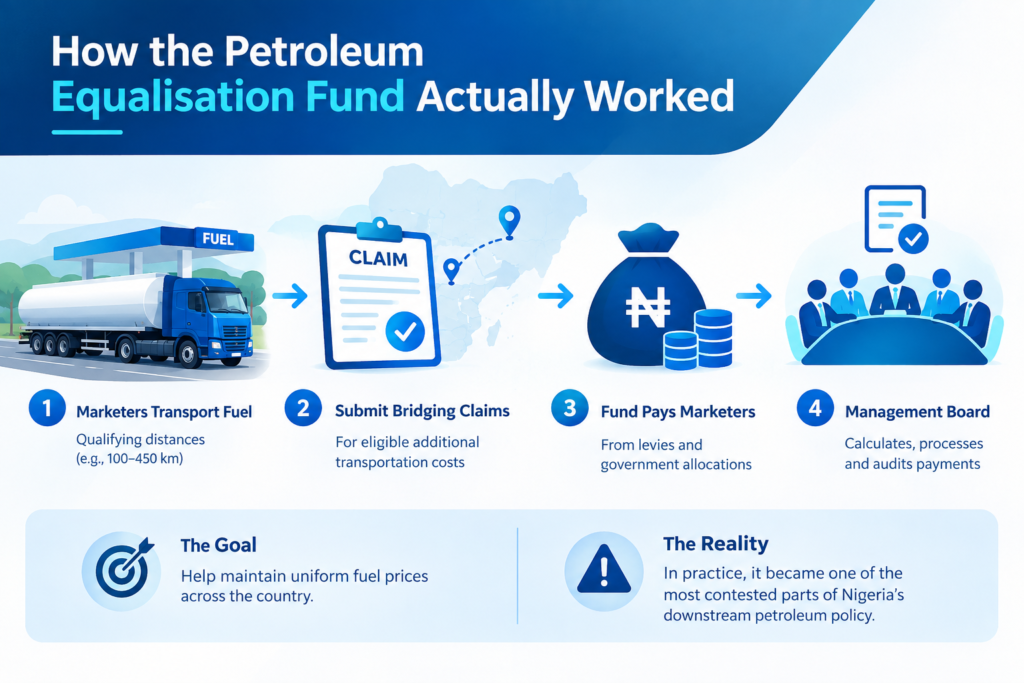
The Petroleum Equalisation Fund (PEF) operated mainly through a system known as “bridging claims.” Marketers transporting petroleum products over qualifying distances could apply for reimbursement of eligible additional transportation costs.
These claims helped marketers supplying fuel to remote areas avoid carrying the full burden of higher haulage costs. This supported relatively uniform petrol prices across different parts of Nigeria.
The fund was mainly supported through a levy included in the petroleum pricing structure along with other revenue allocated to it by the government.
The Petroleum Equalisation Fund Management Board administered the scheme by calculating eligible payments processing marketers’ claims and overseeing the fund’s financial records and audits.
On paper the system provided a way to reduce regional price differences. However its implementation became a subject of significant debate within Nigeria’s downstream petroleum sector.
Why the PEF Drew Criticism
Academic and policy analysis of the PEF over the years has pointed to a recurring set of problems. Researchers examining the fund found that despite its stated goal price uniformity across the country was frequently not achieved in practice with regional price differences persisting even while the equalization mechanism was theoretically in place.
The fund was also linked to opportunities for arbitrage and abuse marketers submitting claims for distances or volumes that did not reflect actual transportation activity which fed into broader concerns about mismanagement within Nigeria’s petroleum subsidy regime more generally. Delays in reimbursing marketers were another recurring complaint with outstanding claims sometimes stretching on for extended periods and creating cash flow strain for companies that depended on timely repayment to keep importing and distributing fuel.
These issues fed into a longstanding policy debate in Nigeria over whether the PEF like the broader fuel subsidy system it was tied to had outlived its usefulness or whether scrapping it would simply remove one of the few tools keeping fuel affordable outside major cities.
What Changed in 2023
The major turning point came in May 2023, when President Bola Tinubu announced the removal of Nigeria’s long-standing petrol subsidy shortly after taking office. Because the Petroleum Equalisation Fund (PEF) and its bridging payments were closely linked to the previous subsidized and price-controlled system, the removal of the subsidy effectively brought an end to the mechanism that reimbursed marketers for qualifying transportation costs. This marked a major change in how petroleum products were priced and distributed across Nigeria.
Under the new arrangement, Nigeria moved toward market-based petrol pricing rather than relying on the previous equalisation system to smooth transportation costs between regions. The Nigerian Midstream and Downstream Petroleum Regulatory Authority (NMDPRA) remains responsible for regulating the downstream petroleum sector while market participants increasingly determine prices based on factors such as supply transportation exchange rates and operating costs. NMDPRA continues to operate regulatory and monitoring systems for the downstream market.
The Legal Wrinkle: Is the PEF Actually Gone?
Here is where the picture gets more complicated than a simple “scrapped” headline suggests. The Petroleum Industry Act 2021 which restructured much of Nigeria’s oil and gas regulatory framework does not eliminate the PEF automatically. Instead the Act allows the fund to continue existing until the government formally determines that the downstream petroleum market has been effectively deregulated at which point the Minister of Petroleum Resources is required to take the specific legal steps needed to wind the fund down and transfer its remaining assets and liabilities to the government.
In other words halting new bridging payments and calling the fund “defunct” in practice is not necessarily the same as the PEF having been formally dissolved as a legal entity under the Act. Public statements from officials and regulators including references to a “defunct” PEF suggest the fund’s operational role effectively ended with subsidy removal but reporting on the fund’s outstanding financial obligations continued well after 2023 including news into 2024 and early 2025 of the NMDPRA working through billions of naira in unpaid claims owed to marketers from the fund’s earlier bridging activity.
That combination an operationally dormant fund still working through legacy liabilities without clear public confirmation that the formal legal wind-down process described in the Petroleum Industry Act has been completed is why the PEF’s exact current status is best described cautiously rather than definitively. Anyone needing a precise legal answer such as a marketer with an outstanding claim or a business assessing regulatory exposure should confirm the current position directly with the NMDPRA rather than relying on media shorthand.
Why the Petroleum Equalisation Fund Matters Beyond Nigeria’s Fuel Market
The Petroleum Equalisation Fund (PEF) offers a useful example of how government-administered subsidy and equalization programs can shape an entire market. Such funds can be created to address regional price differences and market challenges but winding them down can be more complicated when businesses still have outstanding claims liabilities or operational dependencies. The difference between a fund being practically discontinued and being fully dissolved through a legal process can also create uncertainty for companies that previously relied on its support.
For Nigeria’s downstream petroleum sector, the end of the Petroleum Equalisation Fund (PEF) also reflects the broader move toward market-based fuel pricing. Transportation and distribution costs that were once partly offset through government reimbursements can now have a more direct effect on pump prices. This shift can influence regional price differences, distribution costs, and the commercial viability of operating filling stations in different parts of Nigeria.
The Bottom Line
The Petroleum Equalisation Fund was a nearly 50-year-old mechanism built to keep fuel prices consistent across Nigeria by reimbursing marketers for transportation costs. Its operational role effectively ended with the 2023 removal of the petrol subsidy and it is now commonly described as defunct in government statements and media coverage. But because the Petroleum Industry Act requires a specific formal process to fully dissolve the fund and because outstanding claims tied to its earlier operations continued being addressed well after 2023 treating the PEF as entirely closed and settled would be getting ahead of the confirmed facts. For anyone with a direct stake in the matter the safest approach is checking current guidance from the NMDPRA rather than assuming the story ended with the 2023 announcements.
FAQs
Is the Petroleum Equalisation Fund still active in Nigeria?
The Petroleum Equalisation Fund (PEF) became effectively defunct after the 2023 fuel subsidy removal ending its core reimbursement role.
What did the Petroleum Equalisation Fund actually pay for?
The Petroleum Equalisation Fund (PEF) reimbursed marketers for eligible transportation costs helping maintain uniform petroleum prices across Nigeria.
Who regulates Nigeria’s downstream sector now?
After the Petroleum Equalisation Fund (PEF) ended NMDPRA oversees the downstream petroleum sector and works with FCCPC on market pricing and competition.
Why was the Petroleum Equalisation Fund criticized before it wound down?
The Petroleum Equalisation Fund (PEF) faced criticism over regional price disparities potential fraudulent or inflated claims and delays in reimbursing marketers adding to concerns about Nigeria’s broader fuel subsidy system.