


WorkBoard funding rounds provide a useful look at how the OKR and enterprise strategy execution platform has attracted venture capital over time. If you have come across WorkBoard while researching OKR software or enterprise strategy execution tools you may have noticed that the company has raised substantial funding through multiple investment rounds.
Understanding WorkBoard’s funding history can provide context about its growth investors and development as a company. This guide breaks down the WorkBoard funding rounds the investors involved and what each round represented in the company’s broader funding journey.
What Is WorkBoard
WorkBoard is an enterprise software company built around Objectives and Key Results commonly known as OKRs a goal-setting framework originally popularized by companies like Intel and later Google. WorkBoard’s platform helps organizations translate strategic priorities into measurable outcomes giving leadership teams a way to track progress align departments and run more structured planning cycles. The company was founded by Deidre Paknad who serves as CEO and Daryoush Paknad who serves as CTO and it’s headquartered in Redwood City California.
Over time WorkBoard expanded from a niche strategy-alignment tool into a platform used by large enterprises including well-known names in technology telecommunications and other industries that need to coordinate complex strategic initiatives across big organizations.
WorkBoard’s Seed Round
Like most startups WorkBoard funding history began with a seed round which raised $2.75 million. Seed funding at this stage typically goes toward building an initial product hiring a founding team and proving there’s real demand for what the company is building before pursuing larger institutional funding.
Series A: $9.3 Million in 2017
WorkBoard announced its Series A round in December 2017 raising $9.3 million from new investors Floodgate and Microsoft Ventures along with participation from existing investors. Combined with the earlier seed round this brought the company’s total funding to $12.1 million at the time. The Series A funding was earmarked for accelerating sales and marketing efforts around WorkBoard’s software which the company positioned as a tool for enterprises needing to iterate on and measure strategy faster than traditional planning approaches allowed.
This round is a useful marker in WorkBoard’s story because it introduced Microsoft Ventures as a strategic investor a relationship that would continue to show up in later funding rounds through Microsoft’s M12 venture fund.
Series B: $23 Million in 2019
By March 2019 WorkBoard had grown enough to raise a $23 million Series B round led by GGV Capital. This round reflected the company’s expansion beyond its early customer base and into a broader enterprise market as WorkBoard continued building out its platform and sales operations to serve larger organizations with more complex strategy execution needs.
Series C: $30 Million in January 2020
WorkBoard’s Series C round announced in January 2020 brought in $30 million led by Andreessen Horowitz with continued participation from GGV Capital M12 and Workday Ventures. This round came after a year in which the company reportedly tripled its sales and the funding was directed toward scaling marketing go-to-market partnerships and core technology areas like data visualization and machine learning capabilities within the platform. By this point WorkBoard had raised $65 million cumulatively and Andreessen Horowitz general partner David Ulevitch joined the company’s board of directors as part of the deal.
This round is a good example of how growth-stage funding often works: rather than just fueling product development the capital was aimed at accelerating an already-working sales motion and deepening the product’s technical capabilities to keep pace with enterprise customer expectations.
Series D: $75 Million in 2021
WorkBoard’s largest funding round to date came in May 2021 when it raised $75 million in growth funding led by SoftBank Vision Fund 2. Existing investors Andreessen Horowitz GGV Capital Workday Ventures and M12 participated again joined by new investors including Capital One Ventures SVB Capital and Intel Capital. The company said the funds would go toward platform development building out its customer community and further expanding sales and marketing.
This round pushed WorkBoard’s total funding well past $100 million and it’s worth noting the context: 2021 was a period of unusually active venture funding across SaaS and enterprise software with growth-stage companies facing strong investor demand. WorkBoard’s leadership has noted that the company could have raised more than it did given the level of investor interest at the time but chose the amount that fit its growth plans.
How Much Has WorkBoard Raised in Total
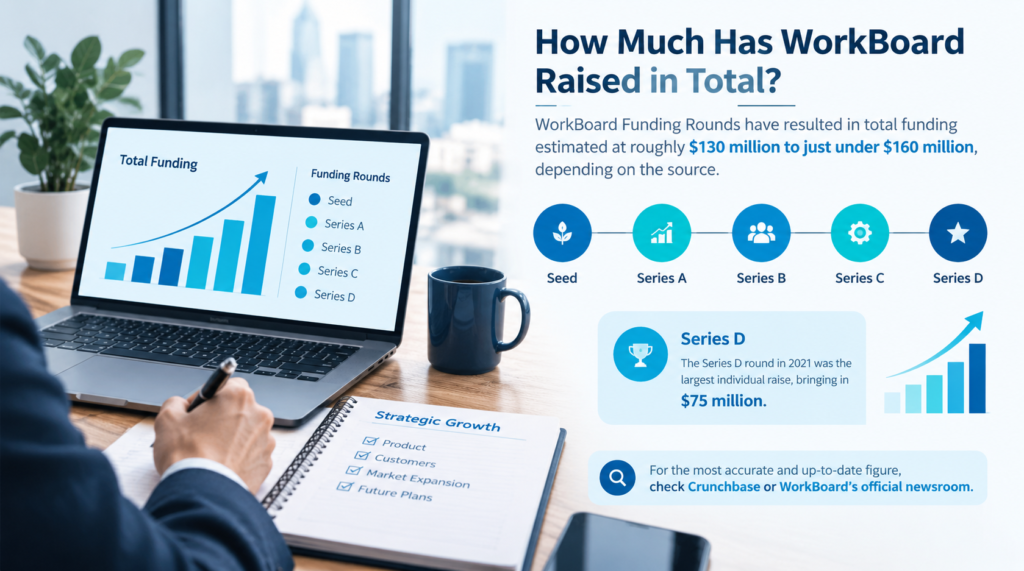
WorkBoard Funding Rounds have resulted in total funding estimated at roughly $130 million to just under $160 million depending on the source and how private funding data is calculated.
The variation in reported totals is not unusual for private companies. Funding databases may use different information from company announcements public filings and estimates when calculating the overall amount.
What remains consistent in the WorkBoard Funding Rounds history is the progression from a seed round through Series A Series B Series C and Series D.
The Series D round in 2021 was the company’s largest disclosed individual funding round bringing in $75 million and taking its cumulative funding well above $100 million.
For the most accurate current figure, readers should check Crunchbase or WorkBoard’s official newsroom as private-company funding totals can change when new financing details are disclosed.
Who Has Invested in WorkBoard
The WorkBoard Funding Rounds have attracted a mix of venture capital firms and strategic corporate investors. Several investors participated in multiple rounds including Andreessen Horowitz GGV Capital M12 (Microsoft’s venture fund) and Workday Ventures.
During the Series D round SoftBank Vision Fund 2 joined as the lead investor. Other participants included Capital One Ventures and Intel Capital adding both financial and corporate investment experience to WorkBoard’s funding history.
The WorkBoard Funding Rounds also show continued involvement from investors such as GGV Capital M12 and Workday Ventures across different stages of the company’s growth.
Corporate investors such as M12 and Workday Ventures can provide more than financial capital. Corporate venture relationships may also create opportunities for technology integrations, partnerships and introductions to enterprise customers.
Overall, WorkBoard’s investor group includes both traditional venture capital firms and corporate venture arms reflecting the different types of investors involved throughout its funding history.
What WorkBoard’s Funding History Suggests
The WorkBoard Funding Rounds show a clear increase in both the size of individual raises and the company’s funding activity over time. The company moved from a $2.75 million seed round to increasingly larger Series A B C and D rounds.
The timing between the WorkBoard Funding Rounds also became shorter as the company progressed into later stages. This pattern is common among companies moving from early development toward broader growth and expansion.
Funding amounts increased significantly across the rounds with the company eventually raising $75 million in its Series D. This was the largest individual round disclosed in the funding history covered in the article.
The WorkBoard Funding Rounds documented in the available history currently end with the Series D round announced in 2021. The provided source does not confirm a later funding round.
Anyone researching WorkBoard’s current fundraising status should therefore verify the latest information through reliable sources, as private-company funding details can change when new financing is disclosed.
Final Thought
WorkBoard funding rounds tell the story of a fairly typical if successful enterprise SaaS trajectory: a modest seed round a series of increasingly large venture rounds tied to genuine sales growth and a late-stage raise backed by a major global investor once the business had proven its model at scale. For anyone evaluating WorkBoard as a vendor a competitor or simply a case study in enterprise software fundraising the consistency of its existing investor base across multiple rounds is arguably just as telling as the total dollar amount raised.
FAQs
How much total funding has WorkBoard raised?
The WorkBoard Funding Rounds are estimated to total around $130 million to just under $160 million, depending on the source.
Who led WorkBoard’s Series D round?
The WorkBoard Funding Rounds included a $75 million Series D led by SoftBank Vision Fund 2 in May 2021 with participation from existing investors.
When was WorkBoard’s most recent funding round?
The latest confirmed WorkBoard Funding Rounds was its Series D announced in May 2021.
Who founded WorkBoard?
WorkBoard was founded by Deidre Paknad who serves as CEO and Daryoush Paknad who serves as CTO.
What does WorkBoard’s software actually do?
The WorkBoard Funding Rounds supported the growth of an OKR and strategy execution platform that helps enterprises set objectives track key results and align teams around measurable strategic goals.